



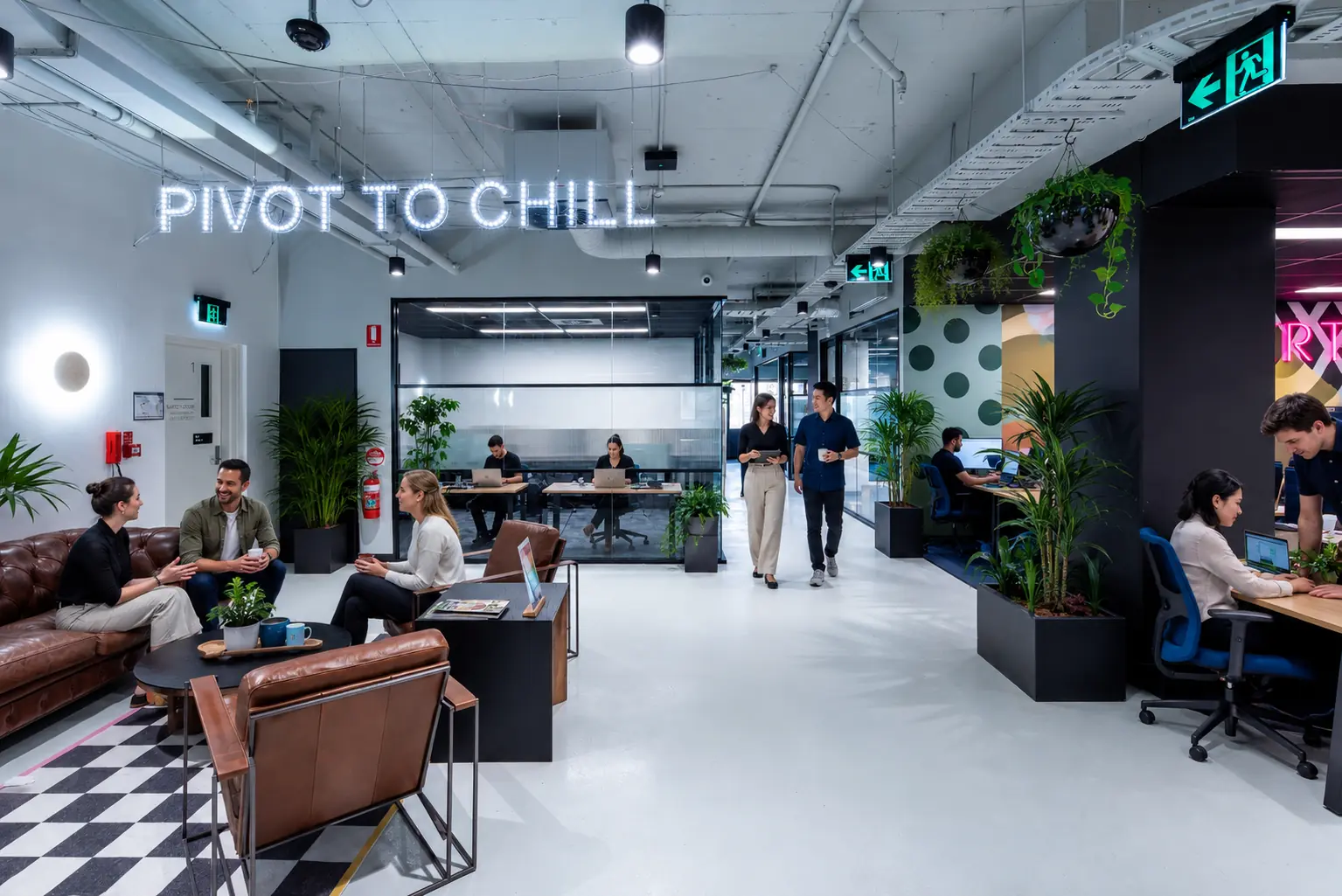
Employee Engagement in Flexible Workspaces
Employee engagement is not created by an office lease.
It is built through meaningful work, trusted leadership, strong relationships and an environment that helps people perform. Yet many mid-sized professional firms continue to rely on traditional offices that were designed for a more predictable working model.
The result can be an expensive workplace that is busy on certain days, quiet on others and disconnected from how employees now choose to work.
Improving employee engagement in traditional offices requires more than asking people to attend more frequently. Professional firms need to give employees a clear reason to be there.
That is where flexible workspaces can make a difference.
By combining private offices, collaborative areas, meeting rooms, shared amenities and greater contract flexibility, the right workspace can support employee motivation, strengthen daily connections and help firms retain valuable people.
What is employee engagement?
Employee engagement describes the strength of the connection an employee feels towards their work, team and organisation.
An engaged employee is not simply satisfied or comfortable. They understand what is expected, feel supported and believe their contribution matters.
Engagement is typically reflected through:
- Motivation and discretionary effort
- Participation in team activities
- Collaboration and knowledge sharing
- Confidence in leadership
- Commitment to organisational goals
- Willingness to recommend the employer
- Intention to remain with the organisation
Workplace engagement is influenced by many factors, including leadership, role clarity, recognition, professional development and team culture. The physical office environment is not the whole answer, but it can either reinforce these factors or work against them.
This challenge is significant. Gallup’s 2026 workplace research found that only 20% of employees globally were engaged during 2025. Engagement across Australia and New Zealand was slightly higher at 21%, placing it broadly in line with the global result. Gallup’s State of the Global Workplace 2026
For professional firms, that represents a serious business issue. When performance depends on expertise, collaboration, client relationships and sound judgement, disengagement can quickly affect service quality and growth.
Why professional firms struggle with employee engagement in traditional offices
Traditional offices were generally built around stable headcounts, fixed attendance patterns and long leases.
Today, employees may divide their time between home, client sites and the office. Teams can be spread across locations, while different roles require very different settings for focused work, confidential conversations and collaboration.
An office designed around permanent desks and enclosed rooms can struggle to support this level of movement.
1. The office no longer matches real attendance
A professional firm may lease enough space for every employee, even when only part of the team attends each day.
This creates an office that can feel empty and flat outside peak attendance periods. Employees arrive expecting connection but find half the team working elsewhere.
It is difficult to generate energy when the room feels like a pre-season training session with half the squad missing.
Flexible workspaces can help firms align their footprint with actual demand while maintaining access to professional meeting and collaboration spaces.
2. Attendance lacks a clear purpose
Employees are unlikely to feel motivated by a commute that leads to a day of individual video calls.
Microsoft research found that employees were strongly motivated to attend a workplace when it offered social connection and opportunities to rebuild team relationships. In its study, 84% cited socialising with colleagues as a motivator, while 85% pointed to rebuilding team bonds.
This means office attendance should be designed around outcomes such as:
- Team planning
- Mentoring and development
- Client meetings
- Creative problem-solving
- Project launches
- Relationship building
- Recognition and celebration
A flexible workspace can provide the variety of settings required to make those moments more effective.
3. The environment offers limited choice
Professional work moves between concentration, conversation, collaboration and confidentiality.
A single open-plan environment rarely handles every requirement well. Employees may struggle with noise during focused work or lack suitable rooms for private client discussions.
A more adaptable office environment can provide:
- Private team offices
- Quiet focus areas
- Phone booths
- Meeting and boardrooms
- Informal collaboration zones
- Breakout areas
- Event and presentation spaces
Choice gives employees greater control over where and how they work. That control can reduce friction and support stronger performance.
4. Traditional offices place additional pressure on internal teams
Managing a leased office involves more than paying rent.
The firm may also be responsible for fitout, utilities, repairs, security, cleaning, technology, reception, furniture and meeting room operations.
For mid-sized professional firms, these responsibilities often fall to operations teams whose time would be better invested in employees and clients.
A serviced flexible workspace can remove much of this operational load. Instead of managing the building, internal leaders can focus on managing the employee experience.
5. The office experience becomes repetitive
Familiarity can be valuable, but a static workplace can lose energy over time.
Without shared events, new interactions or changes in environment, employees can fall into predictable routines that do little to strengthen workplace engagement.
Flexible workspaces introduce opportunities to connect with a broader professional community through:
- Member events
- Educational sessions
- Wellness activities
- Networking opportunities
- Community introductions
- Shared social areas
- Business support initiatives
These experiences should complement the firm’s internal culture, not replace it. The goal is to create more opportunities for employees to participate, connect and grow.
6. Long-term leases cannot easily respond to change
Professional firms rarely grow in a perfectly straight line.
A new client account, project team, merger or regional expansion can quickly change workspace requirements. A traditional lease may leave the organisation with too much space, too little space or the wrong configuration.
That rigidity can affect employees directly. Crowded rooms, empty floors and prolonged fitout delays all shape how people feel about their workplace.
Flexible workspace allows firms to adjust their footprint as requirements change, helping the office remain relevant to the team using it.
How flexible workspaces can improve employee engagement
A flexible workspace will not fix weak leadership, unclear roles or a lack of recognition.
What it can do is create better conditions for connection, motivation and performance.
1. Give employees a destination worth attending
A strong workspace should offer something employees cannot recreate at home.
That may include high-quality meeting rooms, professional hospitality, collaborative environments, social energy and face-to-face access to colleagues.
The workplace becomes a destination for productive interaction rather than a compulsory location.
2. Create more opportunities for connection
Informal interactions matter.
A conversation before a meeting, an introduction in a shared kitchen or a team lunch can strengthen relationships in ways that scheduled video calls often cannot.
Flexible workspaces create more natural opportunities for these moments by bringing people into active, shared environments.
For professional firms, this can also support collaboration across seniority levels. Junior employees gain greater access to experienced colleagues, while leaders have more opportunities to coach, observe and recognise contributions.
3. Support autonomy and employee motivation
Flexibility signals trust.
When employees can choose the environment that best suits their task, they gain greater control over their working day. That may mean completing concentrated work from a quiet area, meeting a client in a boardroom or bringing the team together in a project space.
The principle is simple. Give people flexibility with clarity, not flexibility without structure.
4. Strengthen staff retention
Employees assess their workplace as part of their overall employment experience.
A well-located, professionally managed and thoughtfully designed environment can demonstrate that the firm values its people. Conversely, an office that is difficult to reach, poorly equipped or regularly overcrowded can become a source of frustration.
Flexible workspace can support staff retention through:
- Greater choice in where work happens
- Better access to professional facilities
- Reduced commuting pressure through location options
- More opportunities for team connection
- Improved comfort and workplace functionality
- A more dynamic daily experience
Employees may join for the role, but the quality of their everyday experience often influences whether they stay.
5. Build a more consistent workplace experience
Hybrid work can create two different employee experiences – one for people in the office and another for those working remotely.
A flexible workplace strategy can help leaders coordinate purposeful attendance and provide consistent standards across different locations.
This is particularly useful for firms with distributed teams, employees who work near clients or plans to expand into new markets.
Instead of establishing a complete office in every location, the business can provide access to professional workspaces where employees need them.
6. Make culture more visible
Culture becomes stronger when employees can experience it through action.
Flexible workspaces give firms settings in which to bring their values to life through:
- Team rituals
- Learning sessions
- Leadership briefings
- Client events
- Project showcases
- Recognition programs
- Community initiatives
A company’s culture should not live in a slide deck. It should be visible in how people meet, collaborate and celebrate progress.
When should a professional firm consider flexible workspace?
Flexible workspace may be worth considering when:
- Office attendance fluctuates significantly during the week
- The firm is paying for consistently unused space
- Employees want greater flexibility or location choice
- The current office lacks suitable collaboration areas
- Meeting rooms are frequently unavailable
- The business expects growth, contraction or restructuring
- A lease expiry or break date is approaching
- The firm is entering a new city or market
- Operations teams are spending too much time managing facilities
- The business wants to improve its employee and client experience
The decision should be based on how the firm works, not on following a workplace trend.
Traditional office or flexible workspace?
| Consideration | Traditional office | Flexible workspace |
|---|---|---|
| Contract structure | Usually longer-term | More adaptable terms |
| Space changes | Can require new leasing or fitout | Often easier to expand or adjust |
| Operational responsibility | Mostly managed internally | Many services are included |
| Workplace variety | Depends on the firm’s fitout | Private, shared and collaborative areas |
| Community experience | Must be created internally | Built-in community opportunities |
| Meeting facilities | Limited to leased footprint | Access based on membership or booking |
| Market entry | Requires significant planning and capital | Can support faster activation |
| Brand control | High | Varies by provider and solution |
| Privacy | Controlled through the firm’s premises | Requires careful workspace selection |
A traditional office can still be the right solution for businesses requiring complete environmental control, highly specialised facilities or a permanent large-scale headquarters. Here is a sharp guide that you should compare.
Flexible workspace is often stronger when adaptability, service, employee choice and speed are greater priorities.
How to choose a flexible workspace that supports engagement
Not every flexible office will deliver the same employee experience.
Professional firms should evaluate potential workspaces against the following criteria.
Location and accessibility
Consider public transport, parking, cycling access, surrounding amenity and proximity to clients.
A beautiful workspace loses impact if employees face an unreasonable journey to reach it.
Privacy and confidentiality
Professional firms may handle commercially sensitive, financial or personal information.
Inspect acoustic privacy, secure access, private office configuration, meeting rooms and technology standards before committing.
Variety of work settings
The environment should support focused work, collaboration, confidential calls, client meetings and team gatherings.
Service quality
Reception, cleaning, technology support and day-to-day responsiveness can have a major impact on the employee and client experience.
Community relevance
Look beyond the number of events offered. Consider whether the community, programming and business connections are relevant to your employees.
Flexibility to change
Understand the process and cost involved in adding desks, changing offices, booking project space or accessing other locations.
Brand alignment
The workspace should feel appropriate for the firm, its employees and its clients. A professional address and well-managed environment can reinforce confidence before a meeting even begins.
How to measure workplace engagement after moving
A workspace decision should produce measurable outcomes.
Establish baseline data before the move and review it after three, six and twelve months.
Useful indicators include:
- Employee engagement survey results
- Voluntary staff turnover
- Office attendance by day
- Meeting room usage
- Participation in team events
- Employee referrals
- Absenteeism
- Internal collaboration scores
- Client feedback
- Workspace satisfaction
- Time spent managing office operations
- Cost per actively used workstation
Avoid judging success purely by how many employees enter the office.
Attendance is an activity. Engagement is an outcome.
A practical engagement plan for professional firms
A flexible workspace performs best when it is supported by clear leadership practices.
Before moving
- Survey employees about how they work
- Review attendance and utilisation patterns
- Identify tasks requiring in-person interaction
- Define privacy and technology requirements
- Set engagement and retention benchmarks
During the transition
- Explain why the workplace model is changing
- Show employees how to use each type of space
- Establish clear team attendance rhythms
- Train managers to lead hybrid teams
- Create opportunities for employees to shape the experience
After moving
- Gather regular employee feedback
- Review whether spaces match actual activities
- Track engagement and retention indicators
- Adjust office size or configuration when required
- Maintain purposeful team and community programming
The workspace should evolve with the organisation. It is a platform for performance, not a finished project.
Build a workplace people want to be part of
Professional firms do not need to choose between flexibility and connection.
The right workspace strategy can support both.
Traditional offices can become a barrier when they are expensive, static and disconnected from how employees actually work. Flexible workspaces provide an alternative that can adapt to attendance, create stronger shared experiences and give teams more reasons to connect in person.
At CreativeCubes.Co, we create flexible workspaces that bring together private offices, professional meeting spaces, community and hands-on hospitality. Our environments are designed to help growing businesses focus on their people, clients and momentum while we take care of the workplace around them.
Explore flexible workspace options with CreativeCubes.Co and create an office experience built for your team’s next stage of growth.
FAQs
What is employee engagement in the workplace?
Employee engagement is the emotional and professional connection employees have with their work, team and organisation. It is reflected through motivation, participation, discretionary effort, advocacy and an intention to remain with the employer.
Why is employee engagement difficult in traditional offices?
Employee engagement in traditional offices can suffer when the environment no longer matches attendance patterns or employee needs. Empty desks, limited collaboration spaces, long commutes and a lack of workplace variety can reduce the value employees receive from attending.
Can flexible workspaces improve employee motivation?
Flexible workspaces can support employee motivation by providing greater choice, professional facilities and more opportunities for face-to-face connection. However, the workspace must be combined with effective management, clear expectations, meaningful work and recognition.
How can flexible workspaces support staff retention?
Flexible workspaces can improve the everyday employee experience through better amenities, accessible locations, workspace choice and stronger opportunities for collaboration. These benefits can support staff retention when they align with employee and business needs.
Are flexible workspaces suitable for professional firms?
Yes. Flexible workspaces can suit legal, consulting, accounting, financial, recruitment and other professional firms when they provide appropriate privacy, secure access, meeting facilities, reliable technology and a client-ready environment.
What should a professional firm look for in a flexible office?
Professional firms should assess location, privacy, acoustic performance, security, meeting room access, technology, service quality, contract flexibility and the ability to expand or adjust the workspace.
How can a business measure workplace engagement?
Businesses can measure workplace engagement using employee surveys, voluntary turnover, attendance patterns, event participation, employee referrals, collaboration feedback and workspace satisfaction. These measures should be reviewed together rather than relying on attendance alone.
Does flexible workspace mean coworking in an open-plan area?
Not necessarily. Flexible workspaces can include fully enclosed private offices, dedicated team rooms, meeting suites, quiet areas, business lounges and shared amenities. Firms can choose the level of privacy and interaction that fits their team.