



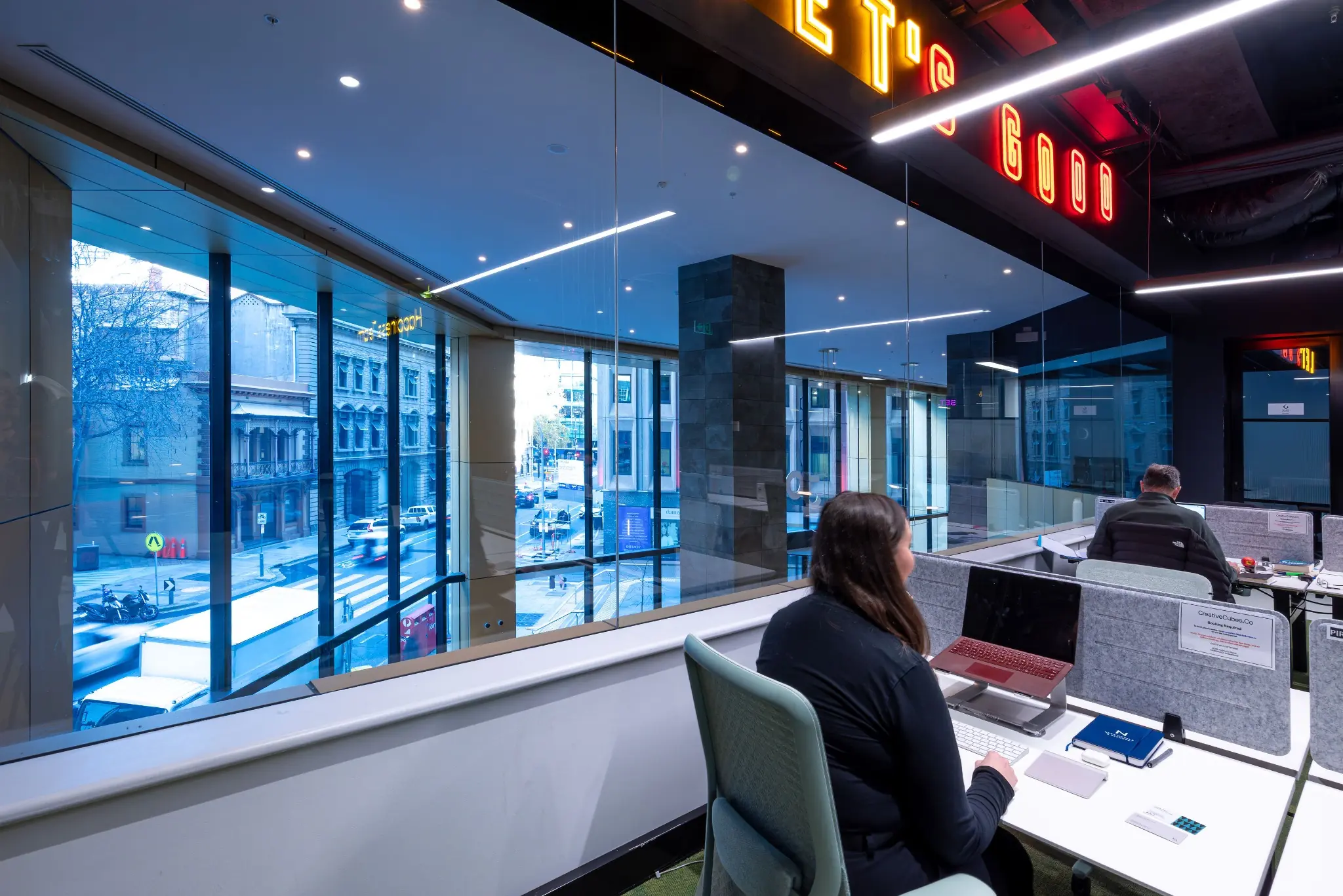
Why SMEs Are Choose Coworking Spaces
For Australian small and medium enterprises, the office is no longer simply a place to put desks. It is a financial commitment, an operational responsibility and a major influence on how teams connect, collaborate and grow.
That is why more founders and small business leaders are exploring coworking spaces for Australian SMEs as an alternative to conventional commercial leases.
A traditional office can provide control, but it can also lock a business into fixed space, upfront capital costs and long-term obligations. Coworking offers a different model: professional space, shared infrastructure and greater freedom to adjust as the business changes.
For an SME, that flexibility can be the difference between carrying unnecessary overhead and investing capital where it creates genuine momentum.
Australian SMEs need offices that move with the business
Australia had approximately 2.81 million actively trading businesses at 30 June 2026. Around 996,000 of those were employing businesses, according to the Australian Bureau of Statistics.
The market is active, but it is also constantly changing. During 2025-26:
- 460,461 businesses entered the market
- 375,331 businesses exited
- The total number of businesses increased by 3.1%
For founders, these numbers reflect a commercial reality: business conditions rarely stand still.
A team of six can become a team of 15. A growth forecast can change. A new client may require additional project space. Hybrid attendance can reduce the number of desks needed each day. A move into another city may become a priority.
Yet a conventional lease is usually built around certainty. It asks the business to predict its future space requirements years in advance.
Coworking does the opposite. It enables the workspace to respond to the business.
Why long-term leases create pressure for SMEs
A traditional commercial lease is not automatically the wrong choice. For stable businesses with predictable staffing, substantial capital and specialised property requirements, it can make sense.
The challenge is that many Australian SMEs do not operate with that level of certainty.
Long-term financial commitments
Commercial leases frequently involve multi-year obligations. Once signed, the business may remain responsible for the space even if its team, operating model or financial position changes.
This can create several layers of cost:
- Rent
- Security deposits or bank guarantees
- Fitout and furniture
- Utilities
- Internet and technology
- Cleaning
- Repairs and maintenance
- Insurance
- Building outgoings
- Make-good obligations
- Legal and property advisory fees
The Australian Government’s business guidance notes that leased premises can involve deposits, advance rent, fitout costs, utilities, insurance and typically annual rent increases. It also highlights that long-term property commitments can make relocation or expansion more difficult. Business.gov.au
Rent is only one line on the office scoreboard. The complete cost of establishing, operating and eventually leaving the space is what matters.
Paying for unused capacity
Growing businesses often lease for the team they expect to have, rather than the team they have today.
That can leave businesses paying for empty desks, underused meeting rooms and space reserved for growth that may take longer than expected.
Hybrid work adds another variable. If different team members attend on different days, the number of leased workstations may bear little relationship to actual daily occupancy.
A larger office may look impressive, but unused space is still an overhead.
Capital tied up in property
Every dollar directed towards a fitout, furniture package or security requirement is a dollar that cannot immediately be invested elsewhere.
For SMEs, that capital may deliver more value when used for:
- Hiring
- Marketing
- Product development
- Technology
- Customer acquisition
- Inventory
- Expansion
- Working capital
Coworking can reduce the amount of capital needed to establish a professional workplace because much of the infrastructure already exists.
Operational distraction
Running an office creates work.
Someone needs to manage internet providers, cleaners, access systems, repairs, deliveries, meeting rooms, utilities and everyday workplace issues. In a small business, those responsibilities often land on a founder, operations manager or senior employee whose time is better spent elsewhere.
Coworking moves much of that operational load to the workspace provider.
The lights are on. The internet is running. The meeting rooms are ready. The coffee machine is behaving, most of the time. The team can arrive and focus on the business.
The financial case for coworking spaces for Australian SMEs
The value of coworking is not necessarily that every individual line item is cheaper. Its advantage is that multiple office costs can be consolidated into a more predictable workplace expense.
Lower establishment costs
A ready-to-use private office can reduce or remove the need for:
- Major fitout expenditure
- Furniture purchases
- Cabling and network installation
- Kitchen construction
- Meeting-room technology
- Reception infrastructure
- Access-control systems
This helps protect cash flow and shortens the time between choosing an office and actually working from it.
More predictable monthly costs
Many coworking agreements bundle several services into one recurring fee, such as:
- Furnished workspace
- Electricity and utilities
- Business-grade internet
- Cleaning
- Shared kitchens
- Meeting-room access
- Reception support
- Building access
- Community programming
Businesses should still confirm exactly what is included, but bundled pricing can make workplace expenditure easier to forecast.
Reduced exposure to surplus space
Coworking allows an SME to select space closer to its current needs.
Instead of leasing 20 desks because the business might eventually need them, it may begin with a private office for 10 and expand when growth occurs.
That turns workspace into a more responsive operating cost instead of a fixed property burden.
Less exit risk
Leaving a conventional office can involve negotiations, make-good work, removal costs and continued rent while a replacement tenant is found.
Flexible agreements can reduce this exposure. Terms vary between providers, so notice periods and exit conditions must still be reviewed carefully, but the commitment can be materially shorter and simpler than a traditional lease.
The operational benefits of flexible office space
The case for coworking is not only financial. It can also improve how an SME operates day to day.
A faster move-in
A conventional office can take months to locate, negotiate, design and build.
A serviced coworking office can often be occupied far sooner. This matters when a business has:
- Hired faster than expected
- Reached the end of another lease
- Entered a new market
- Won a major contract
- Outgrown a home office
- Needed temporary project space
Speed creates options. It prevents property from becoming a handbrake on business growth.
Professional spaces for clients
Working from home can be productive, but it does not always provide the right environment for client meetings, presentations or confidential conversations.
Coworking gives SMEs access to professional facilities without requiring them to build every space themselves.
Depending on the location, that can include:
- Meeting rooms
- Boardrooms
- Private offices
- Event spaces
- Breakout areas
- Podcast or content facilities
- Reception services
- Business lounges
The result is a workplace that can support both everyday work and important commercial moments.
Shared amenities without owning the overhead
An SME may only need a boardroom several times per month. Under a traditional model, it would still pay for that room every day.
Coworking allows multiple businesses to share premium amenities. Each business gains access without carrying the full property cost individually.
It is the workplace equivalent of having a deep bench without putting every player on a full-time contract.
Support for hybrid work
Hybrid teams need more than rows of desks. They need a workplace that gives people a reason to come together.
Effective coworking environments can support hybrid teams through:
- Private areas for focused work
- Meeting rooms for collaboration
- Reliable video-conferencing facilities
- Informal breakout spaces
- Flexible memberships
- Day access for remote employees
- Event and community programming
The office becomes a destination for connection, alignment and momentum, rather than somewhere employees attend out of habit.
Commercial real estate flexibility as a growth tool
For SMEs, flexibility is not an escape hatch. It is a strategic capability.
A flexible workspace can help a business respond to:
- Sudden recruitment
- Seasonal workforce changes
- Project-based teams
- Market expansion
- Business restructuring
- Hybrid attendance patterns
- Short-term client requirements
Scaling up
If the team grows, the business may be able to add desks, move into a larger office or combine adjoining spaces without relocating the entire organisation.
Scaling down
If requirements change, a flexible agreement may allow the business to reduce its footprint at the end of a shorter commitment period.
That matters because responsible leadership is not only about preparing for growth. It is also about avoiding unnecessary fixed costs when conditions shift.
Testing a new market
An SME entering Melbourne, Geelong or another business market may not be ready to commit to a permanent leased office.
Coworking provides a lower-friction way to establish a local presence, meet customers and assess demand before making a larger property decision.
Coworking can strengthen business connections
Traditional offices tend to place one business behind one door. Coworking introduces businesses to a wider professional ecosystem.
A strong coworking community may include:
- Founders
- Consultants
- Professional service firms
- Technology companies
- Creative teams
- Investors
- Potential suppliers
- Future employees
- Prospective customers
Not every coffee becomes a contract, and it should not need to. The broader value is proximity to people, ideas and opportunities.
For small business owners, this can reduce the isolation that often comes with leadership. It can also create more natural opportunities to learn, collaborate and build commercial relationships.
Coworking versus a traditional office lease
| Consideration | Traditional lease | Coworking space |
|---|---|---|
| Commitment | Often multi-year | Commonly shorter and more flexible |
| Upfront capital | Potentially significant | Generally lower |
| Fitout | Usually managed and funded by tenant | Workspace is typically ready to use |
| Furniture | Purchased or leased separately | Commonly included |
| Utilities and internet | Managed separately | Frequently bundled |
| Space changes | Can require relocation or renegotiation | May allow easier scaling |
| Meeting facilities | Business carries the full cost | Shared access may be available |
| Workplace operations | Managed by the tenant | Largely managed by the provider |
| Community | Built internally | Access to a broader business network |
| Branding and control | Greater control | Depends on provider and product |
How to evaluate coworking spaces for your SME
Not every coworking space will suit every business. Founders should assess the total workplace experience, not simply compare desk prices.
1. Calculate the total occupancy cost
Compare coworking fees with the complete cost of a lease, including:
- Rent
- Outgoings
- Fitout
- Furniture
- Utilities
- Cleaning
- Internet
- Maintenance
- Insurance
- Security
- Make-good costs
- Internal administration time
A fair comparison should measure the full season, not one quarter.
2. Review agreement flexibility
Ask:
- What is the minimum term?
- How much notice is required?
- Can the office expand during the agreement?
- Can additional desks be added?
- What happens if the business needs less space?
- Are there establishment, exit or restoration fees?
3. Check what is included
Clarify access to:
- Meeting rooms
- Printing
- Internet
- Reception
- Lockable storage
- Parking
- End-of-trip facilities
- Kitchens
- Events
- After-hours access
A low advertised price may not represent the final monthly cost.
4. Test the location
Consider the experience for employees and customers:
- Is the workspace close to public transport?
- Are there cafés and services nearby?
- Is parking available?
- Does the location support recruitment?
- Is the building easy for clients to find?
- Can employees access more than one location?
5. Assess privacy and security
Businesses handling sensitive information should inspect:
- Office acoustics
- Lockable private spaces
- Network security
- Visitor management
- Meeting-room privacy
- After-hours access
- Document storage
Coworking can be collaborative without compromising confidentiality, but the right infrastructure must be present.
6. Experience the community
Tour the space during a normal working day.
Look at how people use the environment. Speak with the community team. Ask about events, introductions and member support.
A beautiful office is valuable. A well-run community makes it work.
When should an SME consider moving to coworking?
Coworking may be a strong fit when:
- Your existing office is too large or too small
- Your lease is approaching expiry
- You want to protect working capital
- Your headcount is difficult to predict
- Your team works remotely or on a hybrid basis
- You need better client-facing facilities
- You are entering a new market
- Office administration is consuming too much time
- You want access to a professional business community
The ideal time to explore long-term lease alternatives is before the current office becomes a problem. Early planning creates more leverage, more choice and fewer rushed decisions.
Why Australian SMEs are choosing a more flexible future
The workplace needs of Australian businesses have changed.
Founders want professional environments, but they also need agility. Teams want flexibility, but they still need connection. Businesses want impressive facilities, but they do not necessarily want to own and operate every element themselves.
That is driving coworking adoption.
The strongest coworking spaces for Australian SMEs combine the professionalism of a dedicated office with the flexibility, shared infrastructure and community of a larger business ecosystem.
For SMEs navigating uncertain costs, changing teams and ambitious growth plans, that combination makes commercial sense.
Find flexible office space with CreativeCubes.Co
CreativeCubes.Co provides flexible workspaces designed for growing Australian businesses.
From private offices and coworking memberships to meeting rooms, event spaces and professional business amenities, our spaces help teams establish quickly, work effectively and scale with greater confidence.
Your workspace should create momentum, not restrict it.
Explore CreativeCubes.Co locations and book a tour
FAQs
Why are Australian SMEs choosing coworking spaces?
Australian SMEs are choosing coworking spaces to reduce upfront office costs, avoid long-term property commitments and gain access to ready-to-use professional facilities. Coworking also allows businesses to adjust their workspace as headcount and operating requirements change.
Are coworking spaces cheaper than traditional offices?
Coworking may offer office cost savings when the complete cost of occupancy is considered. Traditional offices can involve rent, outgoings, fitout, furniture, internet, utilities, cleaning, maintenance and make-good costs. Coworking commonly consolidates many of these expenses into one recurring fee. The exact saving depends on the team, location and agreement.
What is included in a coworking membership?
Inclusions vary, but memberships may provide furnished workspace, business-grade internet, utilities, cleaning, kitchen facilities, meeting-room access, reception services, community events and building access. Businesses should request a complete list of inclusions before signing.
Can coworking accommodate a growing team?
Yes. Many coworking providers offer private offices in different sizes and may allow businesses to add desks or move into larger spaces as their teams grow. Availability and expansion terms should be confirmed before committing.
Is coworking suitable for businesses that need privacy?
Coworking can suit privacy-conscious businesses when the provider offers lockable private offices, secure access, appropriate network infrastructure and acoustically suitable meeting rooms. Businesses should inspect these features and discuss any regulatory or confidentiality requirements directly with the provider.
How does coworking support hybrid work?
Coworking gives hybrid teams access to professional workspace when they need it without requiring the business to maintain a permanently oversized office. Meeting rooms, private offices, shared areas and flexible access can support collaboration, focused work and team connection.
What should an SME look for in a coworking space?
An SME should assess total cost, location, agreement length, included services, internet reliability, privacy, meeting facilities, access hours, scalability and community support. The space should meet current requirements while providing room for the business to change.
Is coworking a suitable long-term lease alternative?
Yes. Coworking can be a practical long-term lease alternative for businesses that value flexibility, predictable costs and professionally managed facilities. However, businesses requiring extensive customisation or highly specialised premises may still prefer a conventional lease.