



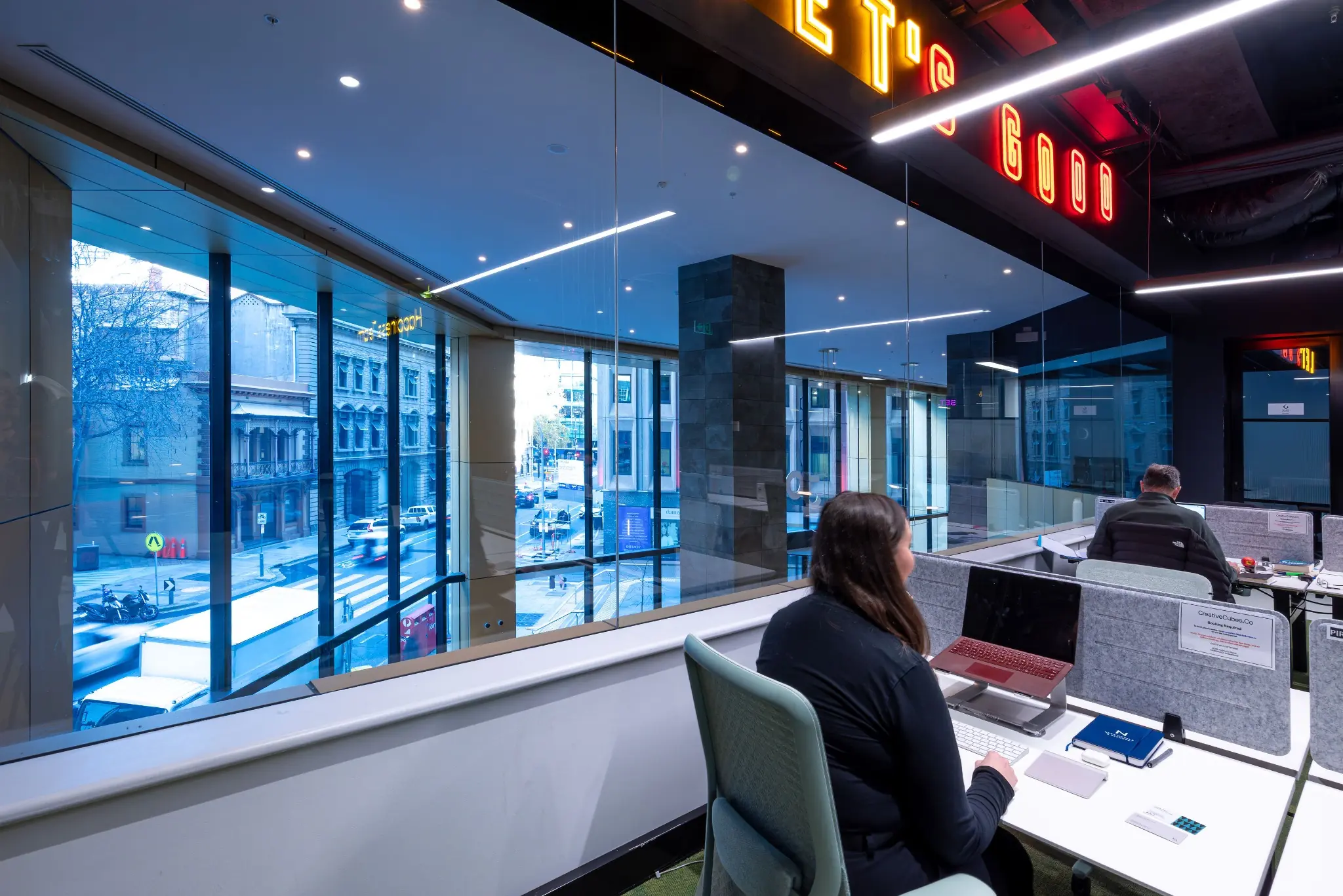
Growth rarely follows a neat floor plan.
One quarter, your team needs more desks. The next, new hires are working across different cities. A major project may require extra meeting rooms for three months, while a new client could create demand for a larger team base almost overnight.
For growing Australian SMEs, the workplace needs to keep pace without becoming a financial or operational anchor. That is why more business leaders are comparing coworking spaces vs traditional office leases before committing to their next move.
Flexible workspace gives businesses access to professional offices, coworking areas, meeting rooms and virtual services without forcing them to predict their space requirements years in advance. It turns the office from a fixed liability into a platform for growth.
This guide explains the available options, the risks of conventional leases and how to choose a workplace that fits the business you are building.
What is a flexible workspace?
A flexible workspace is a professionally managed workplace that gives a business greater choice over how much space it uses, how long it commits and which services are included.
Depending on the provider and location, flexible office solutions may include:
- Private, lockable offices
- Coworking or business lounge memberships
- Dedicated desks
- Meeting and boardrooms
- Project spaces
- Day offices and casual passes
- Virtual office memberships
- Event and presentation spaces
- Shared kitchens, breakout areas and wellness facilities
Unlike a traditional leased office space, the workplace is generally ready to use. Furniture, internet, utilities, cleaning, reception and shared amenities may be bundled into a single agreement and recurring fee.
That simplicity matters. SMEs can focus their capital and leadership attention on customers, people and growth rather than managing an office fitout and a collection of suppliers.
Coworking spaces vs traditional office leases
The central difference is control versus commitment.
A traditional lease gives a business control over a defined premises, often for several years. The tenant may be responsible for the fitout, furniture, utilities, internet, cleaning, maintenance, security and make-good obligations at the end of the term.
A flexible workspace gives the business access to a managed environment under more adaptable terms. It may provide less freedom to customise every detail, but it can deliver significantly greater agility.
| Consideration | Traditional office lease | Flexible workspace |
|---|---|---|
| Commitment | Commonly multi-year | Shorter and more adaptable options |
| Setup | Fitout and furnishing usually required | Typically ready to move into |
| Upfront capital | Often substantial | Generally lower |
| Capacity changes | Difficult within a fixed footprint | Easier to add or reduce space |
| Operating services | Managed by the tenant | Commonly managed by the provider |
| Meeting facilities | Limited to the tenant’s premises | Shared rooms may be booked as needed |
| Network and community | Built by the business | Often available through the workspace |
| Cost visibility | Multiple variable expenses | More services may be consolidated |
Neither model is automatically right for every business. A large, stable organisation with predictable headcount and highly specialised premises may value a conventional lease. A growing SME with changing space requirements will often place a higher value on flexibility, speed and reduced exposure.
Why growing SMEs outgrow long-term leases
The problem is not always that a business physically runs out of room. Often, it outgrows the assumptions made when the lease was signed.
1. Headcount changes faster than the property cycle
A lease may run for three, five or more years. Hiring plans can change in a matter of months. If a business takes too little space, the office becomes cramped. If it leases for projected growth that does not arrive on schedule, it pays for empty desks.
Flexible workspace improves office space scalability by allowing businesses to secure the space they need now and expand as requirements become clearer.
2. Hybrid work changes daily attendance
Headcount no longer tells the full story. A 40-person business may have only 20 to 30 people in the office on a typical day, followed by a near-full house for a team session.
A fixed office designed around maximum attendance can sit underused for much of the week. A flexible model can combine a right-sized private office with shared meeting rooms, coworking areas and additional spaces available when demand peaks.
3. Growth creates new geographic needs
An SME may win clients in another city, hire remote talent or need a professional base closer to a new market. Opening another conventional office can be slow and expensive.
Access to a wider workspace network can give teams a credible presence and a productive place to work without duplicating the cost and complexity of a second headquarters.
4. Capital is tied up in non-core assets
Fitouts, furniture, meeting-room technology, deposits and professional fees can consume capital before the team has completed its first day in the office.
Those expenses are among the most significant long-term office lease challenges for SMEs. Flexible workspaces can reduce upfront requirements and preserve capital for hiring, marketing, product development and customer acquisition.
5. Office management becomes a hidden workload
Running an office involves more than paying rent. Someone must coordinate internet, cleaning, repairs, access, supplies, visitors and room bookings. In a small business, those tasks often land on an operations leader who already has a full agenda.
A managed workspace brings many of those responsibilities under one service model. The result is less operational friction and a more consistent employee and visitor experience.
The main flexible workspace options for SMEs
Flexible workspace is not a single product. The strongest model may combine several options around your team’s work patterns.
Coworking and business lounge memberships
Coworking memberships provide access to shared work areas, often across one or more locations. They suit founders, mobile employees, consultants and distributed teams that need a professional environment without a permanent desk for every person.
They can also give employees a better alternative to working from home or a noisy café, with reliable connectivity, hospitality and access to a broader business community.
Flexible private offices
A private office provides a dedicated, secure base within a professionally managed workplace. It offers greater privacy, consistency and team identity while retaining access to shared services and amenities.
Private offices can work particularly well for SMEs that need:
- A permanent home for a core team
- Privacy for confidential conversations
- A professional setting for clients
- Room to add desks as the business grows
- Access to larger meeting and event facilities without leasing them full-time
This is often the middle lane between open coworking and a conventional lease: your own team space, supported by a much larger workplace ecosystem.
Meeting rooms and boardrooms
Meeting rooms allow SMEs to buy capacity when it is required rather than carrying it every day.
A business might operate from a compact private office, then book a boardroom for a monthly leadership meeting, a project room for a workshop or a presentation space for a major client pitch. It is the workplace equivalent of selecting the right squad for each game instead of paying every player to sit on the bench.
When evaluating rooms, consider technology, acoustic privacy, presentation equipment, catering, guest arrival and booking availability.
Virtual office memberships
A virtual office can provide a professional business address and, depending on the membership, mail handling, reception support or access to physical workspace and meeting rooms.
It can suit businesses that work remotely but want a credible commercial presence, companies testing a new market and founders who do not want to use a residential address publicly.
A virtual membership should support the real business behind the address. Check what is included, where meetings can be hosted and whether the service can grow into physical workspace later.
Day offices and project spaces
Short-term offices and project rooms can accommodate temporary teams, visiting executives, confidential work or a burst of hiring. They give SMEs extra capacity without permanently increasing their footprint.
How flexible workspace supports scalable growth
The best workspace does more than house the team. It creates options.
Scale space with demand
Flexible models can allow a business to add desks, move into a larger office or use shared areas as attendance changes. This aligns property decisions more closely with revenue, headcount and actual utilisation.
Move faster
A ready-to-use office can remove months of property searching, design, construction and supplier setup. That speed can be decisive when a new contract, funding round or market entry creates an immediate workplace need.
Create a stronger employee experience
Professional amenities, varied work settings, quality meeting rooms and hospitality can help smaller companies provide an experience that would be costly to create alone.
This can support productivity, collaboration and recruitment. Employees gain an environment designed for focused work, team connection and client interaction.
Present a credible business presence
For customers, partners and candidates, the workplace is part of the brand. A well-run location, strong arrival experience and access to high-quality meeting spaces can help an SME present with the confidence of a much larger organisation.
Connect with a broader community
Shared workplaces can bring businesses, founders and professionals into the same environment. The value is not forced networking. It is the potential for useful introductions, supplier relationships, referrals and shared knowledge to develop naturally over time.
How to choose the right workspace
Before comparing prices, define how the business actually works.
Map real attendance
Review average and peak attendance by day. Identify how often the whole team gathers and how many people need quiet, collaborative or private space.
Plan for the next stage, not the final destination
Consider likely headcount and operational needs over the next 12 to 24 months. Avoid paying today for a distant projection, but make sure the provider has a credible pathway for expansion.
Calculate the total cost
Compare the complete cost of occupancy, not rent alone. For a traditional lease, include fitout, furniture, internet, electricity, cleaning, security, maintenance, insurance, meeting-room technology and make-good exposure.
For a flexible workspace, clarify inclusions, meeting-room allowances, additional service charges and the cost of adding team members.
Test the employee and client experience
Visit at the times your team is most likely to use the space. Assess noise, natural light, internet reliability, transport, end-of-trip facilities, room availability and the quality of the welcome.
Review privacy and security
Ask how physical access, visitor management, internet security, confidential calls and document storage are handled. Regulated or client-sensitive teams may require dedicated infrastructure or additional controls.
Read the agreement carefully
Understand the term, notice periods, renewal process, price-review structure and rules for changing office size. Flexibility should be visible in the agreement, not just the sales pitch.
Questions to ask a flexible workspace provider
Use these questions when inspecting potential locations:
- Can we add or reduce desks during the agreement?
- What happens if we need a larger private office?
- Which services and utilities are included?
- How are meeting rooms priced and booked?
- Can our team access other locations?
- What security and privacy measures are in place?
- Are there quiet areas for focused work and calls?
- What support is available for visitors, events and technology?
- How does the workspace team build and support its business community?
- What notice periods, annual increases and additional fees apply?
Making the move from a traditional office
A move to flexible workspace does not need to happen all at once.
Some SMEs begin with coworking access for remote employees. Others use a virtual office to establish a new-market presence, book meeting rooms as needed or relocate the core team into a private office while retaining flexible access elsewhere.
The right approach should follow business growth and workspace needs, not a rigid property convention. Start with the work your people need to do, then build the workplace around it.
Build for momentum, not empty desks
When comparing coworking spaces vs traditional office leases, the decision is ultimately about how much certainty the business has and how much adaptability it needs.
Traditional leases can work when requirements are stable and the business wants complete control of a long-term premises. Flexible workspace is often better aligned with growing Australian SMEs that need to move quickly, protect capital, support hybrid teams and scale without repeatedly changing address.
CorporateCubes.Co gives growing businesses access to sophisticated private offices, coworking areas, meeting rooms and business services across professionally managed locations. The result is a workplace that can support today’s team while creating room for tomorrow’s opportunity.
Ready to find a workspace that can move with your business? Tour CreativeCubes.Co locations or speak with our team about a flexible solution built around your next stage of growth.
Frequently asked questions
What is the difference between coworking spaces and traditional office leases?
Coworking spaces provide access to shared, professionally managed workplaces under flexible membership terms. Traditional office leases usually involve a longer commitment to a fixed premises, with the tenant managing the fitout, services and ongoing operations.
Are flexible workspaces suitable for established SMEs?
Yes. Flexible workspaces are not limited to freelancers or early-stage startups. Private offices, enterprise suites, boardrooms and multi-location access can support established SMEs that require privacy, brand presence and room to grow.
Are coworking spaces cheaper than traditional offices?
Not always on a simple per-desk comparison. The stronger measure is total occupancy cost. Flexible fees may include furniture, internet, utilities, cleaning, reception and shared facilities that would be separate costs under a traditional lease.
Can a flexible workspace support a hybrid team?
Yes. A business can combine a right-sized private office with coworking access, meeting rooms and bookable project spaces. This provides more capacity on busy days without requiring a permanent desk for every employee.
How much office space does an SME need?
The answer depends on peak attendance, work styles, privacy requirements and meeting demand rather than total headcount alone. Review actual attendance patterns before choosing a footprint, then allow for practical near-term growth.
What should an SME look for in a private office?
Prioritise privacy, security, natural light, internet reliability, meeting-room access, transport, shared amenities and the ability to expand. The agreement should also clearly state inclusions, additional fees and notice requirements.
What is a virtual office membership?
A virtual office membership provides a professional business address and may include services such as mail handling, reception support and access to meeting rooms or workspace. It suits remote businesses, market-entry teams and founders who want separation between their home and business addresses.
Can we move from coworking into a private office later?
Many flexible workspace providers allow businesses to change products as they grow, subject to availability and agreement terms. Ask about the upgrade pathway before joining so the workplace can support the next stage.
What are the biggest long-term office lease challenges for SMEs?
Common challenges include forecasting future space needs, funding a fitout, managing multiple suppliers, paying for underused capacity and carrying make-good or exit obligations. These risks are amplified when headcount and hybrid attendance change quickly.
Why choose CorporateCubes.Co?
CorporateCubes.Co combines premium private offices, shared workspaces, meeting and event facilities, professional services and a connected business community. SMEs gain a credible workplace today with the flexibility to adapt as their teams and ambitions grow.