



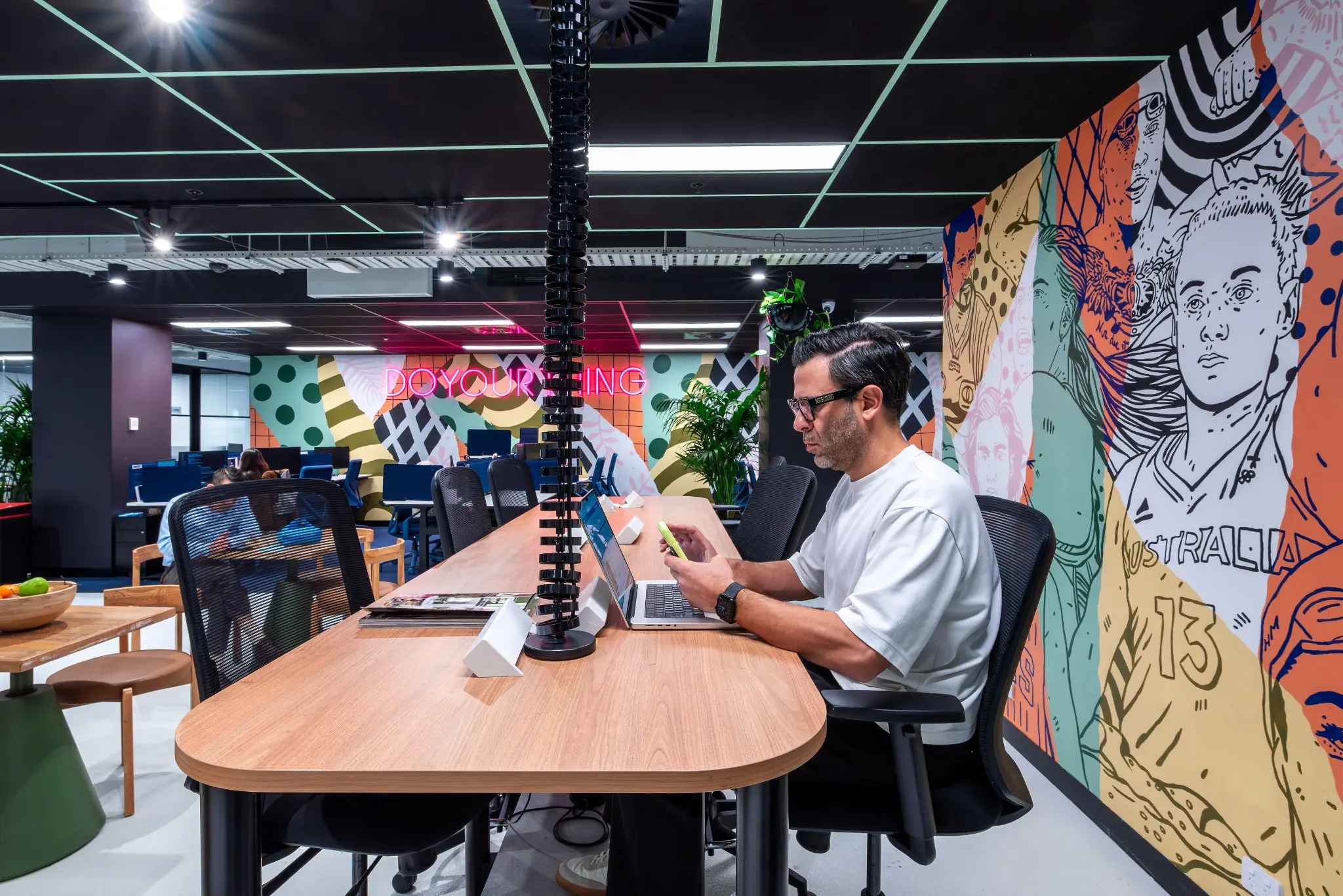
The Complete Guide to Small Team Coworking Moves
For small businesses, the office needs to do more than provide desks. It should help people focus, collaborate, meet clients and feel connected to the company.
Traditional offices can deliver that environment, but they also bring long leases, fitout costs, maintenance obligations and limited room to adapt. When the team grows, contracts or changes its working rhythm, the office rarely moves at the same speed.
That is why more small teams are exploring coworking spaces as practical, professional alternatives to traditional offices.
This guide explains why teams make the move, what to compare and how to choose a coworking space that supports your people, operations and next stage of growth.
What Is a Coworking Space?
A coworking space is a professionally managed workplace shared by individuals and businesses. Depending on the membership, teams may have access to:
- Private offices
- Dedicated desks
- Shared work areas
- Meeting and boardrooms
- Phone booths and focus rooms
- Kitchens and breakout areas
- Reception and visitor support
- Business-grade internet
- Events and community programs
- Flexible membership or licence terms
Modern coworking is not limited to freelancers working from communal tables. Many coworking spaces now provide secure, private and fully serviced workspaces for established small businesses and growing teams.
The result is an office experience without the traditional burden of independently leasing, fitting out and managing an entire workplace.
Why Small Teams Leave Traditional Offices
Traditional leases can work well for businesses that have predictable headcounts, substantial capital and long-term certainty. Small teams rarely operate with all three.
For a growing business, taking a conventional office can mean committing to a fixed footprint before knowing exactly what the company will need in two or three years.
1. Long-term commitments create unnecessary risk
A traditional commercial lease may require a business to commit to a location and floor area for several years.
That can create problems when:
- Headcount changes
- A business adopts hybrid work
- New markets create different location needs
- Revenue fluctuates
- Team structures change
- The company requires more or less space
A flexible workspace can give a team room to adapt without treating every change as a property transaction.
2. Office setup requires significant capital
The advertised rent is only one part of the cost of establishing an office. A business may also need to fund:
- Design and fitout
- Furniture
- Meeting-room technology
- Internet installation
- Security systems
- Utilities
- Insurance
- Cleaning
- Repairs and maintenance
- End-of-lease make-good obligations
Coworking spaces combine many of these requirements into one managed workplace solution. This can preserve capital for recruitment, technology, marketing and other growth priorities.
3. Small teams carry the full operational load
In a traditional office, someone must manage access, suppliers, meeting rooms, deliveries, cleaning and workplace issues.
For a small business without a dedicated facilities team, those responsibilities often fall to a founder, office manager or operations leader. Every hour spent chasing an internet technician is an hour taken away from the actual business.
A managed coworking environment removes much of this friction.
4. Hybrid work changes space requirements
Remote work has given teams more choice, but it has also made workplace planning less predictable.
A business might have 15 employees but only eight attending the office on an average day. On collaboration days, however, the entire team may need desks, meeting rooms and social space.
The right small team workspace accommodates both patterns. It provides a reliable home base while giving the business access to additional spaces when required.
5. Conventional offices can feel isolated
A private office can offer control, but it may also leave a small team working in a quiet, disconnected environment.
Coworking spaces place businesses inside a broader professional community. Teams can retain their privacy while gaining access to shared amenities, events and informal connections with other members.
For a small business, that additional energy can make the workplace feel more active and engaging.
Coworking Spaces Versus Traditional Offices
| Decision area | Traditional office | Coworking space |
|---|---|---|
| Commitment | Typically longer-term | More flexible membership terms |
| Setup | Business manages fitout and furniture | Usually ready to occupy |
| Upfront costs | Often substantial | Generally lower |
| Operations | Managed internally | Managed by the workspace provider |
| Growth | Limited by the leased footprint | Easier to add or reduce space |
| Amenities | Funded exclusively by the tenant | Shared across the wider community |
| Community | Dependent on the individual building | Often supported through events and programming |
| Brand control | Greater control over the entire premises | Varies by workspace and office type |
| Privacy | High | High within suitable private offices |
| Cost structure | Multiple expenses and suppliers | Often consolidated into one regular fee |
Neither model is automatically right for every business. The better option depends on how much flexibility, control and operational support the team requires.
When Is Coworking the Right Office Replacement?
Coworking may be an effective office replacement when a business:
- Has approximately two to 30 team members
- Expects its headcount to change
- Operates a hybrid or flexible work model
- Wants to avoid a major fitout investment
- Needs a professional client-facing environment
- Requires meeting rooms without leasing them permanently
- Wants to move quickly
- Has no internal facilities function
- Values community, events and business connections
- Wants access to multiple locations
The strongest sign is uncertainty. If you cannot confidently predict your team size, attendance pattern or location needs several years ahead, flexibility has genuine commercial value.
Like selecting a playing squad, the objective is not to fill every available position. It is to build the right structure for the people who actually need to perform.
How to Evaluate Coworking Spaces
A beautiful reception area can create a strong first impression, but the daily workplace experience matters more. Evaluate each option against clear operational criteria.
1. Start With Your Team’s Real Attendance
Before touring coworking spaces, understand how the team currently works.
Review:
- Total number of employees
- Typical daily attendance
- Peak attendance
- Preferred office days
- Frequency of client meetings
- Number of video calls
- Need for confidential conversations
- Expected headcount over the next 12 to 24 months
Do not choose a workspace based only on total headcount. A 15-person hybrid team may need a different solution from a 15-person team that attends five days a week.
2. Choose the Right Workspace Type
Coworking spaces can offer several workspace formats.
Shared coworking memberships
These provide access to communal desks and shared facilities. They can suit mobile teams, consultants and businesses with low daily attendance.
Dedicated desks
Dedicated desks give individual team members a consistent workstation within a shared environment.
Private offices
A private office provides a secure room reserved for one business, supported by the wider amenities of the coworking space.
This is often the strongest traditional office alternative for small teams that need privacy, consistency and room to collaborate.
Hybrid workspace packages
Some providers combine a private team base with shared workspace or multi-location access. This can help businesses support employees who work across different parts of Melbourne.
3. Assess Privacy and Security
Coworking should not require a team to compromise on confidentiality.
Ask whether the workspace provides:
- Lockable private offices
- Secure building access
- Visitor management
- Private meeting rooms
- Sound-managed phone booths
- Reliable data security practices
- Secure internet options
- Lockable storage
- After-hours access controls
Professional services, finance, recruitment, healthcare and technology businesses may have particularly important confidentiality requirements.
4. Review Meeting-Room Access
Meeting rooms are one of the most important decision points for small teams.
Clarify:
- How many hours are included
- Whether credits expire
- The cost of additional bookings
- How far ahead rooms can be reserved
- Whether rooms support video conferencing
- The available room sizes
- Whether external guests can attend
- Whether refreshments or catering can be arranged
A low-priced membership can become expensive if the team frequently pays for additional meeting-room access.
5. Test the Technology
Reliable technology is workplace infrastructure, not a bonus feature.
During your evaluation, examine:
- Internet speed and redundancy
- Wi-Fi coverage
- Video-conferencing equipment
- Printing and scanning
- Power access
- Mobile reception
- IT support
- Meeting-room booking systems
- Access-control technology
If possible, arrange a trial day and test the space during its busiest period.
6. Compare the Complete Cost
Compare like with like. Do not measure a coworking membership against the base rent of a traditional office.
A complete comparison should include:
- Rent or membership fees
- Outgoings
- Utilities
- Internet
- Furniture
- Cleaning
- Reception
- Security
- Meeting-room costs
- Maintenance
- Fitout depreciation
- Make-good obligations
- Internal time spent managing the workplace
The best flexible office space is not necessarily the cheapest. It is the option that provides the strongest combination of flexibility, service, location and team experience.
7. Examine Contract Flexibility
The contract should reflect the flexibility promised during the sales process.
Review:
- Minimum term
- Notice period
- Security deposit
- Price review conditions
- Renewal process
- Expansion options
- Downsizing rights
- Included services
- Additional charges
- Exit conditions
- Access across other locations
Ask what happens if your team grows halfway through the agreement. A capable provider should be able to explain the pathway clearly.
8. Consider Location and Commuting
A strong location should work for employees as well as clients.
Consider proximity to:
- Train stations
- Tram routes
- Major roads
- Parking
- Cycling infrastructure
- Cafés and restaurants
- Gyms
- Childcare
- Client locations
- Employee residential areas
For a hybrid team, commute quality can directly influence attendance. The office must be worth travelling to.
9. Evaluate the Workplace Experience
Walk through the space as if you were arriving for a normal working day.
Ask yourself:
- Does the space feel welcoming?
- Is there enough natural light?
- Are the work areas comfortable?
- Can people focus without constant distraction?
- Are there places for informal conversations?
- Is the environment clean and professionally managed?
- Does the community feel relevant to the business?
- Would employees feel proud bringing clients here?
The physical space is only part of the product. The team running it will shape the experience every day.
10. Understand the Community Offering
Community is valuable when it creates relevant opportunities, not when it simply fills a calendar.
Look for:
- Member introductions
- Educational events
- Social activities
- Wellness initiatives
- Business partnerships
- Local community connections
- Content or promotional opportunities
- Support from an active community team
The best communities allow connection to happen naturally. Participation should be available, not compulsory.
A Practical Coworking Evaluation Scorecard
Score each potential workspace from one to five.
| Criterion | Weight | Questions to consider |
|---|---|---|
| Location | 15% | Is it convenient for employees and clients? |
| Workspace quality | 15% | Does the environment support focus and collaboration? |
| Flexibility | 15% | Can the agreement and space adapt? |
| Total cost | 15% | Is the complete cost commercially sustainable? |
| Privacy and security | 10% | Can confidential work be completed safely? |
| Meeting facilities | 10% | Are the rooms available, equipped and affordable? |
| Technology | 10% | Is the infrastructure reliable? |
| Service and community | 10% | Will the team receive useful support and connections? |
This approach helps prevent a decision from being driven by one impressive feature or an attractive introductory price.
How to Plan the Move
Once you have selected a preferred coworking space, build a simple transition plan.
Step 1: Confirm the exit requirements
Review your current lease, notice period, make-good responsibilities and supplier contracts.
Step 2: Finalise the new agreement
Confirm the office size, included services, start date, access arrangements and all additional charges in writing.
Step 3: Communicate with the team
Explain why the business is moving and how the new workplace will support employees. Share transport options, access instructions and available amenities.
Step 4: Reduce unnecessary equipment
Most coworking spaces are already furnished. Audit existing furniture, technology and storage before moving anything.
Step 5: Protect business continuity
Plan the transition of internet services, mail, phone systems, insurance and business registrations where required.
Step 6: Establish new working rhythms
Decide how the team will use the new space. This might include collaboration days, meeting protocols, remote-work expectations and booking procedures.
Step 7: Review the experience
After 30, 60 and 90 days, ask employees what is working and what needs adjustment.
Common Coworking Mistakes to Avoid
Choosing on price alone
The lowest monthly fee may exclude meeting rooms, after-hours access or other essential services.
Underestimating peak attendance
A workspace that works on a quiet Friday may be uncomfortable when the full team arrives on Tuesday.
Ignoring acoustic privacy
An attractive office can still be unsuitable if every call can be heard from the adjoining workspace.
Failing to test the commute
A central location is not automatically convenient for the people using it.
Overlooking future growth
Choosing a space with no expansion pathway may force another move sooner than expected.
Assuming every coworking community is the same
The quality of service, programming and member experience can vary significantly between providers and locations.
Why CreativeCubes.Co Works for Small Melbourne Teams
CreativeCubes.Co creates flexible workplaces where small teams can focus on their business while the day-to-day workspace experience is taken care of.
Our Melbourne locations combine private offices, coworking areas, meeting rooms, event spaces and community support within professionally managed environments.
Small businesses can access:
- Flexible workspace options
- Furnished private offices
- Professional meeting rooms
- High-speed connectivity
- Welcoming shared amenities
- Community events and introductions
- Support from an on-site team
- Options designed to accommodate growth
Your office should create momentum, not consume it.
Explore CreativeCubes.Co locations and workspace options or speak with our team about finding the right Melbourne workspace for your business.
Frequently Asked Questions
Are coworking spaces suitable for small teams?
Yes. Many coworking spaces provide private offices, dedicated desks and hybrid memberships specifically suited to small teams. The right option depends on attendance, privacy, meeting-room and growth requirements.
How much do coworking spaces cost?
Pricing varies according to the location, office size, membership type, contract term and included services. Compare the complete monthly cost, including meeting rooms, internet, utilities and support, rather than looking only at the advertised desk rate.
Can a coworking space replace a traditional office?
Yes. A private office inside a coworking environment can provide a secure team base while including amenities, meeting rooms and operational support that a business would otherwise manage independently.
What is included in a coworking membership?
Inclusions vary between providers. Common inclusions may cover workspace access, internet, utilities, furniture, kitchens, reception services and community programs. Meeting-room use, printing, parking and after-hours access may involve additional charges.
Are coworking spaces secure?
Professional coworking spaces typically use controlled building access, visitor procedures and lockable private offices. Businesses should still confirm the provider’s physical security, internet practices and confidential meeting options.
Do coworking spaces support remote and hybrid work?
Yes. Coworking can give remote and hybrid teams a consistent place to meet, collaborate and connect without requiring every employee to attend every day.
Can we expand our office as the team grows?
Many flexible workspace providers allow members to move into larger offices or add memberships, subject to availability. Ask about expansion pathways before signing.
What should we look for during a coworking tour?
Inspect the work areas, meeting rooms, phone booths, internet, acoustics, amenities and overall atmosphere. Visit during a busy period and ask detailed questions about inclusions, contract terms and additional costs.