

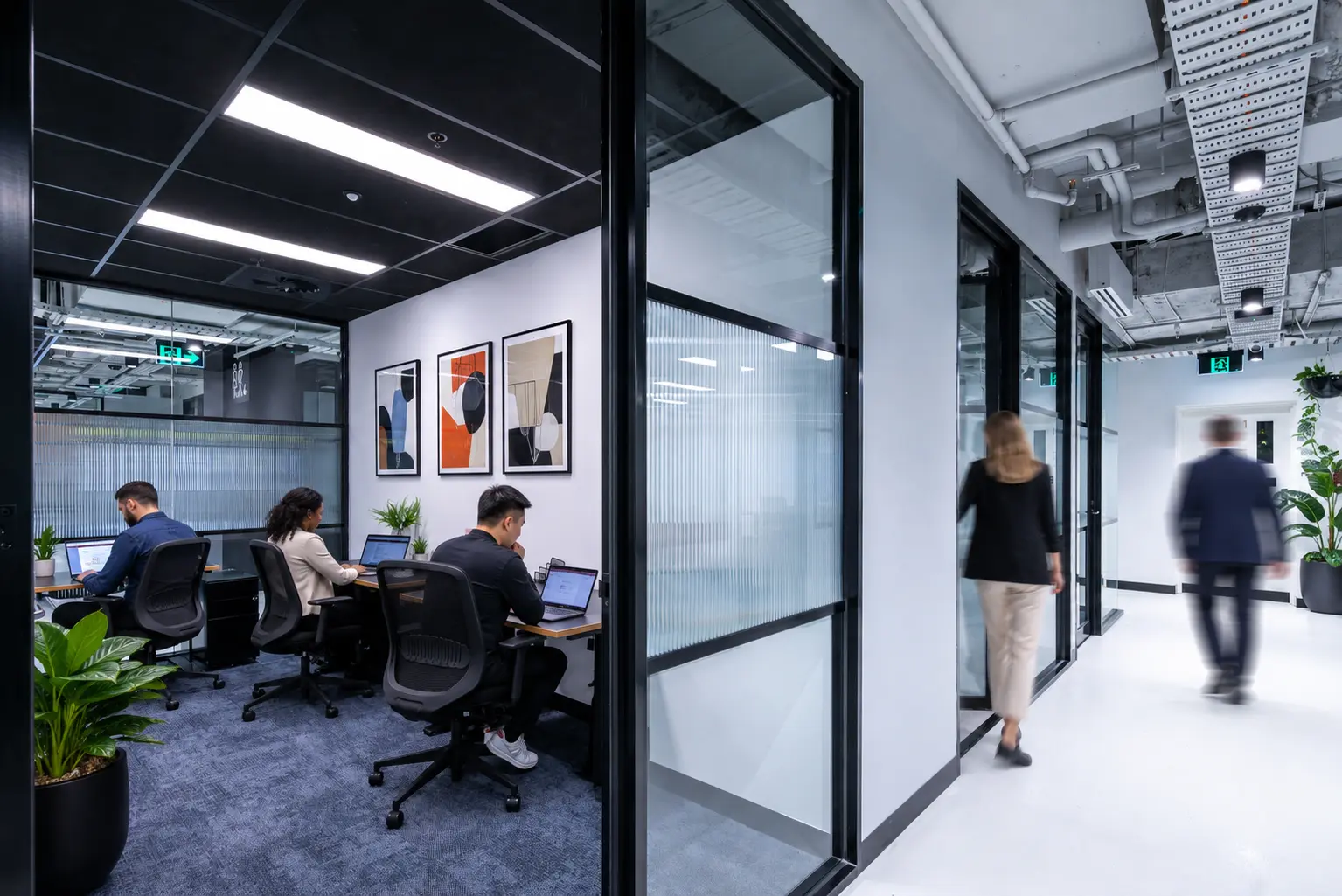
Private Offices for Growing Teams
Growth is exciting. It can also make yesterday’s office solution feel completely inadequate.
A team of four becomes eight. New employees need desks. Client meetings become more frequent. Phone calls require privacy. Hybrid schedules create fluctuating attendance. Suddenly, the spare room, home office or shared coworking table is no longer supporting the way the business operates.
This is where flexible office space becomes a powerful growth tool.
A serviced private office gives your team a secure, dedicated workspace within a professionally managed environment. You gain privacy, business-grade amenities and room to scale without taking on the cost, complexity or long-term commitment of a traditional commercial lease.
For small business owners and operations managers, it can be the difference between an office that restricts growth and a workspace that actively supports it.
What Is a Serviced Private Office?
A serviced private office is a secure workspace reserved exclusively for your team within a flexible or coworking environment.
Unlike an open coworking membership, your employees work together behind a private, lockable door. However, the office is supported by shared professional facilities such as:
- Meeting rooms
- Reception services
- Business-grade internet
- Breakout spaces
- Kitchens and cafés
- Event spaces
- Cleaning and maintenance
- Printing facilities
- Community areas
- Onsite support teams
The workspace is generally furnished and ready to use, allowing a business to move in and begin operating without managing a major fitout, purchasing furniture or coordinating multiple service providers.
It combines the privacy of a traditional office with the adaptability of flexible office space.
Why Growing Teams Need More Than Just Desks
A growing business does not simply need more seats. It needs an environment capable of supporting a more complex operation.
As headcount increases, teams require stronger communication, better meeting facilities, dependable technology and clearer separation between focused work and collaboration.
The right workspace for growing teams should support:
- Employee concentration
- Confidential conversations
- Team collaboration
- Client presentations
- Hybrid work patterns
- Recruitment and onboarding
- Brand credibility
- Future headcount growth
Trying to manage these requirements from a small home office or an inflexible lease can quickly become distracting and expensive.
A private office creates a professional base while keeping the business agile.
1. Your Team Gets Genuine Privacy
Open-plan coworking spaces can be excellent for freelancers, remote workers and early-stage businesses. As a team grows, however, privacy becomes increasingly important.
Employees may need to discuss:
- Financial information
- Customer accounts
- Commercial negotiations
- Recruitment decisions
- Product development
- Legal matters
- Internal performance
- Confidential projects
A private office gives the team a controlled environment for these conversations.
It also reduces background noise and interruptions, helping employees maintain focus while still giving them access to the energy and shared amenities of the broader workspace.
You get your own home court, without losing access to the wider competition, connections and community around you.
2. Flexible Office Space Makes Scaling Easier
Predicting future headcount is difficult.
A business may sign a traditional lease based on its current team, only to outgrow the office within 12 months. The alternative is leasing more space than required and paying for empty desks while waiting for the business to catch up.
Neither option is particularly efficient.
Flexible office space allows businesses to choose an office that suits their current needs and adjust as those needs change.
Depending on availability and the workspace provider, a growing team may be able to:
- Move into a larger private office
- Add additional offices nearby
- Use coworking memberships for hybrid employees
- Book extra meeting rooms when required
- Create dedicated project spaces
- Expand across multiple locations
This gives operations managers more control over workplace capacity without forcing the company to make a long-term property decision based on uncertain forecasts.
3. You Avoid the Complexity of a Traditional Lease
A traditional office lease is rarely limited to rent.
Businesses may also need to fund or manage:
- A commercial bond or bank guarantee
- Legal and advisory fees
- Office design and fitout
- Furniture and equipment
- Internet installation
- Utilities
- Cleaning
- Repairs and maintenance
- Security and access systems
- End-of-lease make-good obligations
These responsibilities consume capital and management time before the team has even moved into the office.
By comparison, serviced private offices consolidate many workplace costs and operational requirements into one managed solution.
The office is already furnished, connected and supported. Your team can focus on customers, performance and growth while the workspace provider manages the environment around them.
4. Professional Amenities Are Ready From Day One
Growing businesses need to present professionally, but building a complete workplace independently can be expensive.
A flexible private office provides access to facilities that may be difficult for a small team to justify on its own.
These can include:
- Boardrooms
- Training rooms
- Podcast and media facilities
- Reception services
- High-speed internet
- Phone booths
- Breakout areas
- Wellness facilities
- Event venues
- Hospitality services
The business only needs to maintain its private office while benefiting from a broader workplace ecosystem.
It is similar to joining a high-performance training facility. You gain access to equipment, support and infrastructure that would be costly to build for one team alone.
5. Private Offices Support Hybrid Work
Hybrid work has changed the way businesses calculate their space requirements.
A company may employ 20 people without needing 20 permanent desks every day. Attendance can fluctuate based on team schedules, client commitments and individual working arrangements.
A flexible small team workspace can combine:
- A core private office
- Shared coworking areas
- Bookable meeting rooms
- Day offices
- Business lounges
- Additional desks when required
This allows businesses to create a workplace around actual attendance rather than maximum theoretical capacity.
Employees retain a professional base for collaboration, connection and focused work, while the company avoids carrying unnecessary space.
6. The Workplace Helps Attract and Retain Talent
Candidates consider more than salary and job title. They also look at the environment in which they will spend a significant part of their week.
A poorly located, outdated or isolated office can make recruitment more difficult. A well-designed flexible workspace can strengthen the employee experience through:
- Convenient locations
- Quality end-of-trip facilities
- Comfortable work areas
- Professional meeting spaces
- Community events
- Hospitality
- Networking opportunities
- A stronger sense of energy and belonging
A private office gives employees a clear team identity while the wider coworking environment creates opportunities to connect with other professionals and businesses.
This balance can be particularly valuable for small teams that want the energy of a larger workplace without losing their own culture.
7. Your Business Gains a More Professional Presence
The workplace communicates something about the business before a meeting begins.
Inviting a prospective client into a professional reception area, boardroom or event space can create greater confidence than meeting at a crowded café or trying to accommodate visitors in a small home office.
A flexible private office can provide:
- A recognised business address
- Professional guest reception
- Bookable meeting rooms
- Presentation technology
- Catering options
- Event and activation spaces
These amenities help growing businesses compete with larger organisations without carrying the same property overheads.
8. Workspace Costs Become More Predictable
Traditional offices can create fragmented and unpredictable expenses.
Rent may be only one part of the monthly workplace cost. Utilities, repairs, cleaning, technology and facility management can all arrive through separate invoices.
Many serviced private offices bundle core workplace services into a single recurring fee. Inclusions vary, but the arrangement may cover:
- Office furniture
- Internet
- Utilities
- Cleaning
- Building access
- Reception support
- Maintenance
- Shared amenities
This makes budgeting easier and gives decision-makers a clearer view of the real cost of accommodating each employee.
When comparing office alternatives, businesses should assess total occupancy costs rather than comparing the advertised rent alone.
9. Your Team Can Join a Business Community
A private office provides security, but it does not need to create isolation.
The best flexible workspaces bring together founders, small businesses, professional firms, scaleups and established brands within one connected environment.
This can create opportunities for:
- Referrals
- Partnerships
- New customers
- Supplier relationships
- Professional learning
- Team events
- Informal knowledge sharing
These connections are not guaranteed, but the environment creates more opportunities for them to happen.
For a growing business, one valuable introduction can sometimes deliver more value than another line in the office lease.
10. The Workspace Can Change With the Business
Growth is rarely linear.
A business may expand quickly, pause recruitment, establish a project team or enter a new market. A rigid office commitment can make these changes harder to manage.
Flexible workspace gives the company more options.
Instead of treating the office as a fixed property asset, the business can treat it as a service that evolves alongside headcount, operations and strategy.
This is one of the strongest reasons private offices have become credible office alternatives for growing businesses. They provide professional infrastructure without forcing the company to predict exactly where it will be several years from now.
Private Office vs Traditional Office Lease
| Consideration | Serviced Private Office | Traditional Office Lease |
|---|---|---|
| Commitment | Flexible terms may be available | Usually a longer commitment |
| Setup | Furnished and operational | Fitout and setup required |
| Internet and utilities | Often included | Managed separately |
| Meeting rooms | Shared facilities available | Must be created within the tenancy |
| Reception | Often available onsite | Business must provide its own |
| Scalability | Easier to expand or adjust | Limited by the leased premises |
| Maintenance | Managed by the provider | Generally the tenant’s responsibility |
| Community | Access to a wider business network | Usually limited to the individual company |
| Upfront capital | Typically lower | Can be significant |
| Move-in time | Often relatively fast | May require months of preparation |
Every provider and lease is different. Businesses should compare the complete commercial terms, inclusions and responsibilities before making a decision.
When Is a Private Office Right for Your Team?
A private office may be suitable if:
- Your team has outgrown working from home
- Open coworking areas no longer provide enough privacy
- You regularly host clients or partners
- Your headcount is expected to change
- You need professional amenities without building them yourself
- You want to avoid a long-term lease
- Your operations team is spending too much time managing the office
- You need a stronger environment for recruitment and culture
- Your hybrid team needs a reliable base
- You are entering a new city or market
The key question is not simply, “How many desks do we need?”
It is, “What workspace will help this team perform now while giving the business room to move next?”
What to Look for in Flexible Office Space
Before choosing a private office, evaluate the complete experience rather than focusing only on the room.
Location
Consider public transport, parking, surrounding amenities and travel requirements for employees and clients.
Office capacity
Check whether the office comfortably supports the current team and whether larger spaces are available if headcount increases.
Privacy and security
Review door access, acoustic privacy, data security, visitor management and after-hours access.
Meeting facilities
Confirm how meeting rooms are booked, what is included and whether additional usage attracts a fee.
Internet reliability
Ask about connection speed, redundancy, network security and technical support.
Included services
Understand exactly what the monthly fee covers, including utilities, cleaning, furniture and reception services.
Contract flexibility
Review the agreement term, notice requirements, deposit, renewal conditions and options for expansion.
Workplace culture
Visit during a normal working day. The energy, service and community should align with the experience you want for employees and visitors.
Onsite support
A responsive workplace team can make a major difference when coordinating meetings, resolving facility issues or welcoming important guests.
Build the Office Around the Business
The strongest workspace strategy is not about securing the largest office available. It is about creating the right environment for the next stage of the business.
Private offices provide growing teams with their own secure space, professional amenities and the ability to scale within a broader flexible workspace ecosystem.
There is less operational friction. Less capital tied up in fitout. Less pressure to predict future headcount perfectly.
Most importantly, the workplace can move at the speed of the business.
CreativeCubes.Co provides flexible office space designed for ambitious teams that want privacy, community and room to grow. From serviced private offices and coworking spaces to meeting rooms and event facilities, businesses can access the infrastructure they need without being boxed into a traditional office model.
Ready to find a workspace that can grow with your team? Explore CreativeCubes.Co private offices and book a tour today.
FAQs
What is flexible office space?
Flexible office space is a professionally managed workplace offered through adaptable membership or licence arrangements. It can include coworking desks, serviced private offices, meeting rooms and shared business amenities without requiring the business to establish a complete traditional office.
What is included in a serviced private office?
Inclusions vary between providers. Common features include furniture, internet, utilities, cleaning, secure access and use of shared facilities. Some workspaces also provide reception services, meeting rooms, kitchens, breakout areas and community events.
Are private offices suitable for small teams?
Yes. Private offices can suit small teams that need a secure, professional environment without committing to a conventional commercial lease. They are particularly useful for businesses managing growth, hybrid attendance or confidential work.
How is a private office different from coworking?
Coworking generally involves working from shared desks or common areas. A private office is reserved exclusively for one business and usually has secure access. Private office members can still use shared coworking amenities and community areas.
Can a growing team expand within a flexible workspace?
Expansion depends on availability and the provider’s portfolio. Some businesses can move into a larger office, add another office or combine private space with coworking memberships and meeting room access.
Is flexible office space cheaper than a traditional lease?
The answer depends on the location, team size, agreement and services included. Businesses should compare the total occupancy cost, including fitout, furniture, utilities, cleaning, internet, maintenance and internal management time, rather than comparing rent alone.
Are serviced private offices suitable for hybrid teams?
Yes. A private office can provide a consistent base for collaboration while additional coworking areas, meeting rooms or day offices accommodate employees when attendance increases.
How quickly can a team move into a private office?
Move-in times vary, but serviced private offices are generally furnished and operational. This can allow businesses to move more quickly than establishing an office under a traditional commercial lease.