

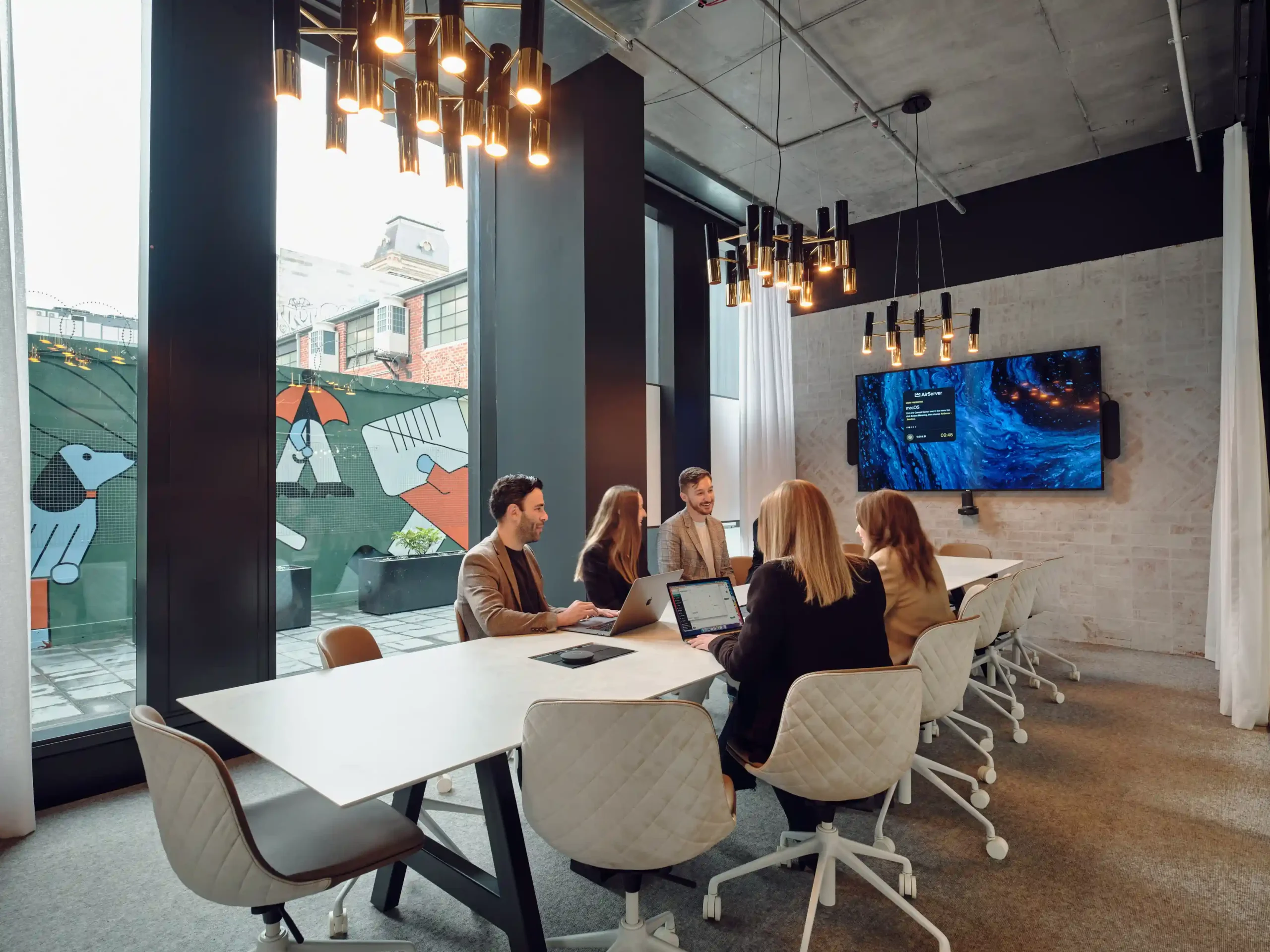
Growing businesses need space to move – not leases that lock them in.
For many Australian SMEs, choosing between a coworking membership, a private office and traditional leased office space is a major operational decision. The right workspace can support recruitment, productivity and expansion. The wrong one can leave the business carrying unnecessary costs, unused space and restrictive commitments.
This guide compares coworking and private offices across different growth stages, helping business owners and operations leaders choose a workspace that can scale with their ambitions.
What is the difference between coworking and a private office?
Coworking and private offices can both sit within a flexible workspace, but they serve different needs.
A coworking membership typically provides access to a shared business lounge or open workspace. Members can choose where they work while accessing communal facilities, meeting rooms and a professional community.
A private office gives one business a secure, dedicated space. The office remains exclusively available to the team, while shared amenities and workspace services are managed by the provider.
Both options can provide greater office space scalability than a traditional long-term lease.
| Workspace option | Best suited to | Privacy | Scalability | Typical commitment |
|---|---|---|---|---|
| Coworking membership | Individuals and small teams | Moderate | High | Flexible |
| Serviced private office | Established or growing teams | High | High | Flexible |
| Traditional office lease | Larger, stable organisations | High | Limited | Long term |
Coworking spaces vs traditional office leases
The central difference between coworking spaces vs traditional office leases is how much responsibility and risk the business carries.
A traditional lease generally gives the tenant control over a defined space. However, it can also involve a long commitment, fitout costs, furniture, utilities, maintenance, cleaning, security and make-good obligations.
Coworking spaces consolidate many of these requirements into a managed workspace solution. Businesses gain access to professional facilities without needing to build and operate an office independently.
Coworking can offer:
- Flexible membership terms
- Furnished and ready-to-use workspaces
- Reception and onsite support
- Meeting rooms and event spaces
- Business lounges and shared amenities
- Opportunities to connect with other members
- The ability to add or reduce workspace as requirements change
- Access to multiple locations, depending on the provider
A traditional office lease may involve:
- Multi-year lease commitments
- Significant upfront fitout expenses
- Bank guarantees or security deposits
- Furniture and technology procurement
- Separate utility and service agreements
- Ongoing office management
- Maintenance and make-good obligations
- Limited flexibility if the team grows or contracts
Ownership of the workplace can sound attractive. Operational responsibility is less attractive when the business needs to focus its energy on customers, people and growth.
The long-term office lease challenges facing Australian SMEs
Traditional leases can work for businesses with predictable headcount, established capital and stable long-term requirements. Growing SMEs rarely enjoy that level of certainty.
The most common long-term office lease challenges include the following.
Paying for tomorrow’s headcount today
A growing business may lease a larger office to accommodate future recruitment. Until those positions are filled, it is paying for space that produces little value.
The opposite problem can be just as costly. If the team grows faster than expected, the business may outgrow its office while remaining tied to the lease.
High upfront establishment costs
A traditional leased office space may require considerable investment before anyone can begin working. Design, construction, furniture, meeting-room technology, connectivity and branding can quickly consume capital that could otherwise support business growth.
Reduced ability to respond to change
New contracts, restructures, hybrid working patterns and economic changes can reshape workspace demand quickly. Long lease terms do not always match the pace at which SMEs need to make decisions.
Additional operational workload
Operating an office requires ongoing attention. Someone must coordinate repairs, cleaning, access, deliveries, utilities, suppliers and meeting-room requirements.
These tasks may appear minor individually, but together they can distract operations teams from higher-value work.
Complex exit obligations
The cost of a traditional lease does not always end when the business leaves. Make-good requirements, legal fees and reinstatement works can add further expense at the end of the term.
Which workspace suits each stage of business growth?
Business growth and workspace needs should be assessed together. The right choice depends on the size of the team, how employees work and what the business is likely to need next.
Stage 1: Solo operator or early-stage business
A coworking membership is often the strongest starting point for a solo founder, consultant or early-stage business.
It provides a professional environment without the cost and isolation of establishing a standalone office. Members can work alongside other professionals while gaining access to meeting rooms when clients or collaborators visit.
Coworking may be suitable when:
- The business has one to three people
- Employees work remotely or across multiple locations
- Client meetings happen occasionally
- The team values professional energy and connection
- Future workspace requirements remain uncertain
At this stage, flexibility is usually more valuable than dedicated square metres.
Stage 2: Small team building momentum
Once a business begins recruiting consistently, a private office may become more practical.
A dedicated office gives the team a clear home base, greater privacy and stronger brand identity. It can also support confidential conversations and focused collaboration.
A private office may be suitable when:
- The business has a growing permanent team
- Employees regularly collaborate in person
- Privacy and security are important
- The company wants a consistent workspace
- Meeting rooms are used frequently
- Headcount may continue to change
The key advantage is that the business receives its own office without taking responsibility for the entire workplace operation.
Stage 3: Growing SME with hybrid teams
Hybrid teams rarely need one assigned desk for every employee. They need a mix of spaces that can support different activities throughout the week.
This may include:
- Private offices for the core team
- Coworking access for mobile employees
- Meeting rooms for collaborative work
- Quiet spaces for focused tasks
- Event spaces for larger gatherings
- Business lounges for informal meetings
- Access across several locations
A combination of coworking memberships and private offices can deliver better office space scalability than a fixed traditional layout.
The business can match its workspace to actual attendance patterns instead of funding an office designed around full occupancy every day.
Stage 4: Established SME or project-based team
A larger private office or customised flexible workspace may suit an established SME that wants greater control without the burden of a conventional lease.
The provider may be able to accommodate specific layouts, branding, technology requirements or future expansion.
This model can also support:
- Project teams entering a new market
- Businesses establishing an interstate presence
- Companies waiting for a permanent office
- Enterprise teams requiring temporary space
- Organisations managing mergers or restructures
It provides a stable operational base while preserving room to adapt.
Coworking membership or private office: How should you decide?
The decision should be based on how the business operates now and what could change over the next 12 to 24 months.
Choose coworking when:
- Flexibility is the highest priority
- The team is small, remote or mobile
- Workspace attendance changes regularly
- Community and networking matter
- A professional environment is needed without a dedicated office
- The business wants to test a location before making a larger commitment
Choose a private office when:
- The team needs a permanent home base
- Confidentiality is important
- Employees collaborate regularly
- The business wants a stronger physical identity
- Equipment or documents need to remain onsite
- The team is growing but wants to avoid a long-term lease
Some businesses will benefit from using both. A private office can support the central team while coworking memberships provide flexibility for remote staff, contractors or interstate employees.
How flexible office solutions improve scalability
Office space scalability means being able to align the workspace with changing business requirements.
Flexible office solutions make this possible by allowing businesses to adjust space without repeatedly fitting out, operating and exiting conventional offices.
Depending on availability and agreement terms, an SME may be able to:
- Add desks as new employees join
- Move into a larger private office
- Reduce space following a restructure
- Use meeting rooms only when required
- Establish teams in new locations
- Give hybrid employees access without allocating permanent desks
- Host company events within the same workspace network
It is similar to building a strong team bench in sport. You want enough capacity to respond when the game changes, without paying an oversized squad to sit unused every week.
Comparing the true cost of each workspace
Monthly rent alone does not provide a complete comparison.
When evaluating coworking spaces vs traditional office leases, Australian SMEs should calculate the total cost of occupying and operating the workplace.
Traditional lease costs may include:
- Base rent
- Outgoings
- Fitout and design
- Furniture
- Internet and utilities
- Cleaning
- Repairs and maintenance
- Security and access systems
- Reception or office management
- Meeting-room technology
- Insurance
- Legal expenses
- Make-good costs
- Bank guarantees or deposits
Flexible workspace costs may include:
- Membership or office fees
- Meeting-room usage
- Printing or additional services
- Parking
- Event-space bookings
- Optional upgrades
Flexible offices can make workspace expenditure easier to understand because many operational services are included within one agreement.
The goal is not simply to find the lowest advertised price. It is to identify the option that creates the strongest balance between cost, productivity, flexibility and risk.
Questions to ask before choosing a workspace
Before signing an agreement, consider the following questions.
1. How quickly could our headcount change?
If the team could grow materially within the next year, confirm whether the workspace provider can offer larger offices or additional memberships.
2. How often will employees use the office?
Look at real attendance patterns rather than relying on assumptions. Hybrid teams may need fewer desks but more collaborative areas.
3. What is included in the price?
Ask for a clear breakdown covering internet, furniture, cleaning, utilities, meeting rooms, reception, access and other services.
4. What level of privacy do we need?
Businesses handling confidential financial, legal, health or customer information may require a secure private office.
5. Can the workspace support client meetings?
Consider the quality and availability of meeting rooms, reception areas, hospitality services and technology.
6. What happens if our requirements change?
Understand the process for adding memberships, changing offices or expanding into another location.
7. Does the environment reflect our business?
The workspace should support the experience you want to create for employees, customers and prospective talent.
Why Australian SMEs are considering flexible workspaces
Australian SMEs operate in an environment where customer demand, hiring and working patterns can shift quickly. Their workspace should be able to respond at the same speed.
Coworking memberships and serviced private offices allow businesses to secure a professional workplace while protecting agility.
The potential benefits include:
- Lower establishment requirements
- Reduced operational complexity
- Greater flexibility
- Faster market entry
- Improved employee experience
- Access to professional amenities
- More opportunities for community connection
- A clearer pathway for expansion
A traditional lease gives a business an office. A strong flexible workspace can provide the office, services, infrastructure and community needed to help the business perform.
Find the right workspace with CreativeCubes.Co
CreativeCubes.Co provides flexible office solutions for entrepreneurs, growing teams and Australian SMEs.
From energised coworking areas and business lounges to secure private offices, meeting rooms and event spaces, our locations are designed to support every stage of business growth.
Start with the space you need today. Expand when momentum arrives. Stay connected to a professional community built around progress.
Explore CreativeCubes.Co locations and workspace solutions
Frequently asked questions
Is coworking suitable for a growing small business?
Yes. Coworking can be well suited to small businesses with flexible schedules, mobile employees or changing headcount. As the team grows, the business may transition into a private office within the same flexible workspace.
What is the main difference between coworking and a private office?
Coworking provides access to shared work areas, while a private office is dedicated exclusively to one business. Private offices generally offer more privacy, consistency and space for team collaboration.
Are coworking spaces cheaper than traditional office leases?
It depends on the team size, location and workspace requirements. Coworking can reduce upfront and operational costs because furniture, internet, utilities and shared amenities may be included. Businesses should compare total occupancy costs rather than rent alone.
What are the biggest long-term office lease challenges?
Common challenges include extended commitments, fitout expenses, unused capacity, limited scalability, operational responsibilities and end-of-lease make-good obligations.
Can a private office support hybrid work?
Yes. A private office can provide a consistent base for a hybrid team, supported by shared meeting rooms, business lounges and flexible memberships for employees who attend less frequently.
When should an SME move from coworking into a private office?
An SME should consider a private office when the team requires greater privacy, regularly works together onsite, needs permanent equipment or wants a stronger physical business identity.
What should Australian SMEs look for in a flexible workspace?
Look for flexible terms, reliable technology, strong onsite support, professional meeting facilities, accessible locations, high-quality amenities and the ability to expand or reduce space.
Can flexible office solutions help a business expand interstate?
Yes. A workspace provider with multiple locations can help a business establish a presence in another city without immediately committing to a traditional leased office space.