

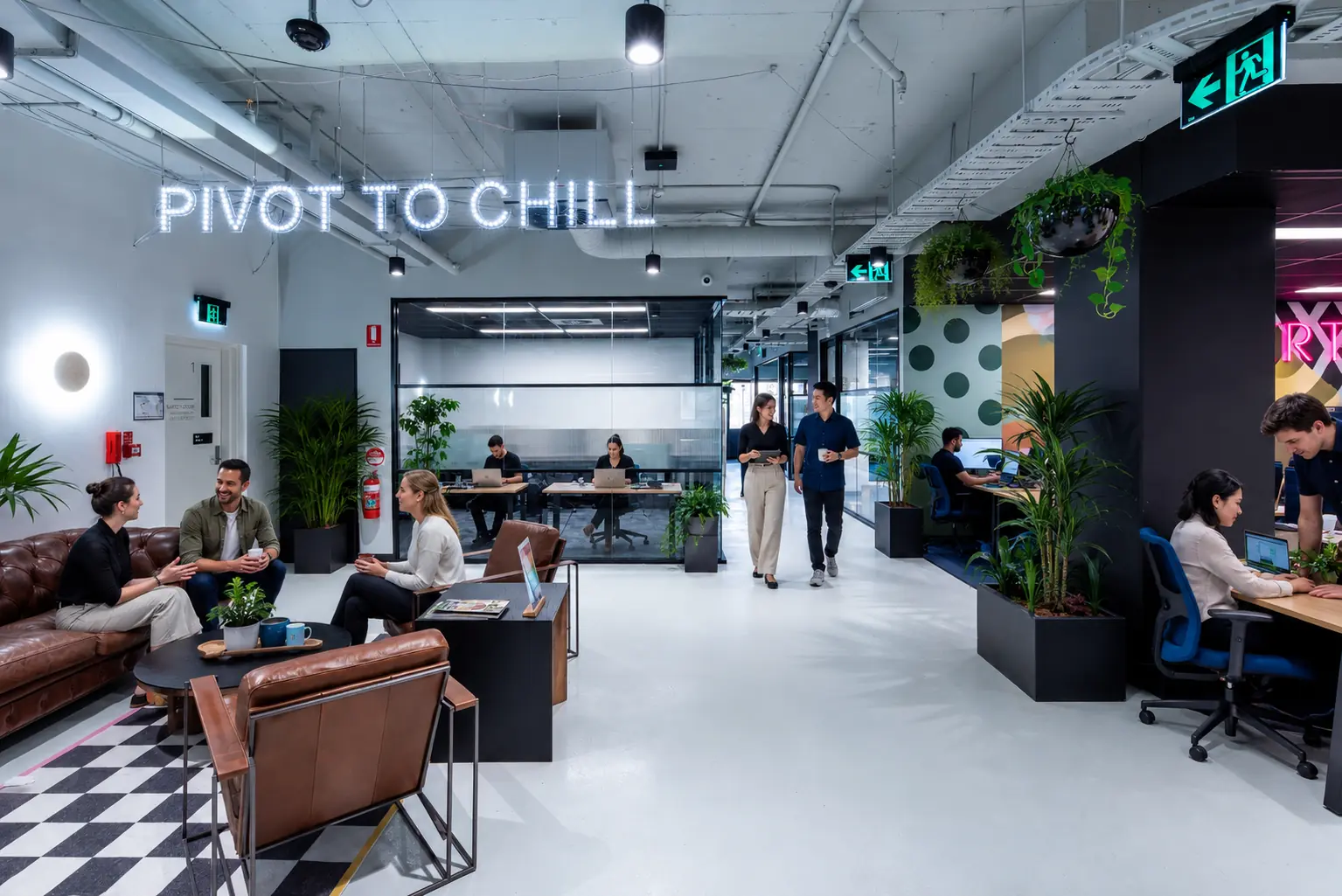
Growth is exciting. It can also expose every weakness in your workspace strategy.
A traditional office may suit your business today. But what happens when you hire ten more people, introduce hybrid work, enter a new market or need more meeting rooms? A space that once felt like an asset can quickly become an expensive constraint.
That is why growing Australian SMEs need to think beyond their immediate headcount. The real decision is not simply how much office space you need now. It is how well that space can adapt to what comes next.
When comparing coworking spaces vs traditional office leases, business leaders should consider flexibility, total cost, scalability, operational demands and the experience they want to create for their people.
Here are the key workspace planning lessons every growing SME should understand.
1. Plan for change, not a perfect forecast
Business growth rarely follows a straight line.
You might win a major account, expand a department, restructure a team or enter a new city sooner than expected. Hybrid working patterns can also change how often people use the office and what they need when they arrive.
A traditional lease generally asks you to predict your workspace requirements years in advance. That is a difficult call for any growing business.
Take too little space and your team may quickly feel restricted. Take too much and you could pay for empty desks while waiting for growth to catch up.
Flexible office solutions give SMEs greater room to adjust. Businesses can often add offices, change configurations or access shared facilities without relocating the entire team.
The lesson is simple: build your workspace strategy around adaptability, not certainty.
2. Understand the full cost of a traditional office
Base rent is only one part of the cost of operating an office.
Traditional leased office space can involve:
- Fitout and design costs
- Furniture and equipment
- Utilities and internet
- Cleaning and maintenance
- Security and access systems
- Meeting room technology
- Kitchen facilities and supplies
- Repairs and ongoing management
- Make-good obligations
- Bank guarantees or security deposits
These expenses can require significant capital before the business has even moved in.
They also create ongoing administrative work. Someone needs to manage suppliers, facilities, repairs, access, cleaning and workplace issues. For a growing SME, that time and capital may deliver more value when directed towards customers, people and expansion.
Coworking spaces and serviced offices commonly combine many of these expenses into a simpler recurring fee. This can provide greater cost visibility and reduce the operational burden placed on internal teams.
When comparing options, assess the total cost of occupancy, not just the advertised rent.
3. Avoid locking tomorrow’s business into today’s footprint
One of the biggest long-term office lease challenges is the mismatch between lease duration and business planning.
A business may understand its requirements for the next 12 months. Predicting its precise team structure, location strategy and workplace habits several years ahead is much harder.
A long-term lease may restrict the business if:
- Headcount increases faster than expected
- Hybrid work reduces daily occupancy
- A department needs to move closer to clients
- The business expands interstate
- A project team only needs space temporarily
- Economic conditions require the company to consolidate
Commercial leases can offer stability, but that stability comes with a commitment. If the workspace no longer suits the business, subleasing, relocating or negotiating an early exit may be costly and time-consuming.
The best workspace should support the next phase of the business without trapping it in the assumptions of the last one.
4. Treat office space scalability as a business requirement
Scalability is not only a technology or staffing consideration. It also applies to workspace.
Effective office space scalability allows a company to expand, contract or reorganise without creating unnecessary disruption.
For example, a growing team may initially need a small private office. As the business develops, it may require additional offices, dedicated project rooms, larger boardrooms or access across multiple locations.
A flexible workspace can give SMEs access to different environments as their needs evolve. This may include:
- Private offices
- Business lounges
- Meeting rooms
- Boardrooms
- Event spaces
- Breakout areas
- Day offices
- Additional locations
This model allows businesses to secure the space they need while accessing larger shared facilities when required.
Think of it like building a strong sporting squad. You want enough capability for today, plus the depth to respond when the game changes.
5. Use real attendance patterns to guide decisions
Headcount does not automatically equal the number of desks required.
A business with 30 employees may not need 30 permanent workstations if team members work across home, client sites and the office. At the same time, reducing desks too aggressively can create frustration on busy collaboration days.
Before making a workspace decision, review:
- Average daily office attendance
- Peak attendance days
- Team collaboration patterns
- Meeting room demand
- Client visit frequency
- Quiet-work requirements
- Remote and hybrid work policies
- Expected hiring over the next 12 to 24 months
This information provides a more accurate picture of business growth and workspace needs.
Flexible workspaces can support changing attendance by combining private offices with shared lounges, meeting rooms and bookable spaces. This allows businesses to plan around actual usage rather than paying for a desk that remains empty most of the week.
6. Do not underestimate the importance of meeting space
Many office decisions focus heavily on desk numbers. Meeting space is often considered later.
That can be a costly mistake.
Growing SMEs need places to meet clients, interview candidates, run workshops, hold confidential conversations and bring hybrid teams together. If meeting rooms are limited, poorly equipped or constantly booked, productivity suffers.
In a traditional office, accommodating occasional large meetings can mean leasing additional space that is underused most of the time.
Coworking spaces can provide access to a wider range of meeting rooms without requiring each business to carry the full cost of those facilities. Teams can book the right room for the occasion, from a quick catch-up to a formal board meeting or company-wide presentation.
Workspace planning should account for how people collaborate, not just where they sit.
7. Consider the experience you are creating for employees
Workspace influences how people feel about coming to work.
Location, natural light, technology, noise levels, amenities and surrounding hospitality can all affect the employee experience. For growing businesses competing for talent, the office can become part of the overall employment proposition.
A well-designed workspace can help employees:
- Feel connected to their colleagues
- Collaborate more naturally
- Separate focused work from social activity
- Meet customers in a professional setting
- Access amenities that improve their working day
- Feel part of a broader business community
A traditional office gives the business significant control over its environment. However, achieving a premium workplace experience may require considerable investment.
Flexible office solutions can provide established facilities, hospitality and community without requiring an SME to build and operate everything independently.
8. Protect capital for the areas that drive growth
Cash committed to an office fitout cannot be used elsewhere in the business.
For many Australian SMEs, capital may be better directed towards:
- Hiring key people
- Product development
- Marketing and customer acquisition
- Technology
- Inventory
- New market entry
- Working capital
This does not mean workspace is unimportant. It means the structure of the workspace commitment matters.
Coworking spaces and serviced private offices can reduce the initial investment needed to establish a professional workplace. Businesses can move into a ready-to-use environment and preserve capital for activities more directly connected to growth.
A strong workspace strategy should enable momentum, not drain it before the first desk is occupied.
9. Factor in the value of speed
Traditional office projects can require property searches, lease negotiations, design work, approvals, construction, furniture procurement and technology installation.
That process can delay expansion or distract leaders from operating the business.
Flexible workspaces can allow teams to move much faster. A furnished private office with internet, meeting rooms and shared amenities may be ready within a much shorter timeframe.
Speed matters when a business:
- Needs to accommodate immediate hiring
- Is entering a new market
- Has secured a major project
- Is relocating after a lease expiry
- Needs temporary space during a transition
- Wants to test a location before making a larger commitment
The ability to move quickly can become a competitive advantage.
10. Match the workspace model to the stage of the business
There is no single workspace model that suits every company.
A traditional office lease may be appropriate for an established business with predictable headcount, specialised fitout requirements and a long-term commitment to one location.
A coworking or serviced office model may be better suited to a business that values flexibility, lower setup costs, multiple locations, shared amenities and the ability to scale.
Coworking spaces may suit businesses that need:
- Flexible agreements
- Faster move-in
- Lower initial capital requirements
- Access to shared meeting and event spaces
- The ability to expand or contract
- A professional environment without facilities management
- Community and networking opportunities
Traditional office leases may suit businesses that need:
- Complete control over design and branding
- Highly specialised infrastructure
- Exclusive access to the entire premises
- A stable long-term footprint
- Space configured around permanent operational requirements
The right answer depends on the company’s stage, financial position and growth outlook.
Coworking Spaces vs Traditional Office Leases: Key Comparison
| Consideration | Coworking or flexible workspace | Traditional office lease |
|---|---|---|
| Commitment | Generally shorter and more flexible | Usually longer-term |
| Setup | Furnished and ready to use | Fitout commonly required |
| Initial capital | Typically lower | Can be substantial |
| Scalability | Easier to expand or adjust | Limited by the leased footprint |
| Facilities | Shared meeting rooms and amenities | Business funds and manages its own |
| Operations | Provider manages the workplace | Tenant manages facilities |
| Branding | Varies by office and provider | Greater control |
| Cost structure | More consolidated | Multiple separate expenses |
| Community | Access to other businesses and events | Dependent on the building and tenant |
| Location expansion | Potential access to a wider network | Separate premises usually required |
Questions to ask before choosing a workspace
Before committing to either model, ask:
- How confident are we in our headcount forecast?
- How often does the team actually use the office?
- What will the workspace cost after fitout and operating expenses?
- Can we expand or reduce our footprint?
- How much meeting and collaboration space do we need?
- Does the location work for employees and clients?
- Who will manage the office day to day?
- What happens if our strategy changes?
- Are there exit, make-good or security obligations?
- Does this workspace help us attract people, customers and opportunities?
If the answers reveal too much uncertainty, flexibility has real strategic value.
Build a workspace strategy that moves with your business
The strongest workspace decision is not necessarily the largest office, the lowest rent or the longest commitment.
It is the option that supports your people, protects capital and gives the business room to move.
For many Australian SMEs, comparing coworking spaces vs traditional office leases reveals that flexibility is not simply a convenience. It is a way to manage risk, respond faster and keep the workplace aligned with growth.
CreativeCubes.Co provides flexible office solutions designed for ambitious businesses. From serviced private offices and business lounges to meeting rooms and event spaces, our locations give growing teams the professional environment, flexibility and community they need to keep moving forward.
Ready to find a workspace that can grow with your business? Explore CreativeCubes.Co locations or book a tour today.
FAQs
What is the main difference between coworking spaces and traditional office leases?
Coworking spaces usually provide furnished, ready-to-use offices through more flexible agreements. Traditional office leases generally involve a longer commitment, a dedicated premises and greater responsibility for fitout, utilities and facilities management.
Are coworking spaces suitable for established Australian SMEs?
Yes. Modern coworking spaces offer private offices, secure access, meeting rooms, professional amenities and flexible growth options. They can support established SMEs as well as startups, project teams and larger organisations.
Is a traditional office lease cheaper than coworking?
Not necessarily. Traditional rent may appear lower when viewed in isolation, but businesses should also account for fitout, furniture, utilities, internet, cleaning, maintenance, security and make-good costs. Comparing the total cost of occupancy provides a more accurate result.
What are the biggest long-term office lease challenges?
The primary challenges include lengthy commitments, high setup costs, limited office space scalability and the risk of paying for space that no longer matches the business. Exiting or modifying a lease may also be difficult.
How much office space does a growing SME need?
The answer depends on attendance, hybrid work arrangements, meeting demand, planned recruitment and the way teams collaborate. Businesses should analyse actual occupancy patterns instead of relying exclusively on total headcount.
Can a flexible office support hybrid work?
Yes. Flexible offices can combine private team space with business lounges, meeting rooms, day offices and shared amenities. This gives employees different environments based on the work they are completing that day.
Can a company customise a coworking office?
Customisation depends on the workspace provider and agreement. Many private offices can support company signage, furniture changes and tailored layouts, while still providing access to shared facilities.
When should an SME consider moving away from a traditional lease?
An SME should review its workspace model when the office is consistently too large or too small, hybrid work has changed attendance, facilities management is becoming distracting or the lease prevents the business from responding to growth.
Why is workspace flexibility important for a growing business?
Flexibility allows the workspace to change alongside headcount, team structure and business strategy. It reduces the risk of being locked into a footprint that no longer supports the organisation.
How can CreativeCubes.Co support a growing SME?
CreativeCubes.Co provides serviced private offices, flexible workspaces, business lounges, meeting rooms and event spaces. Businesses can access a professional workplace and community while maintaining greater flexibility than many traditional leased offices provide.