

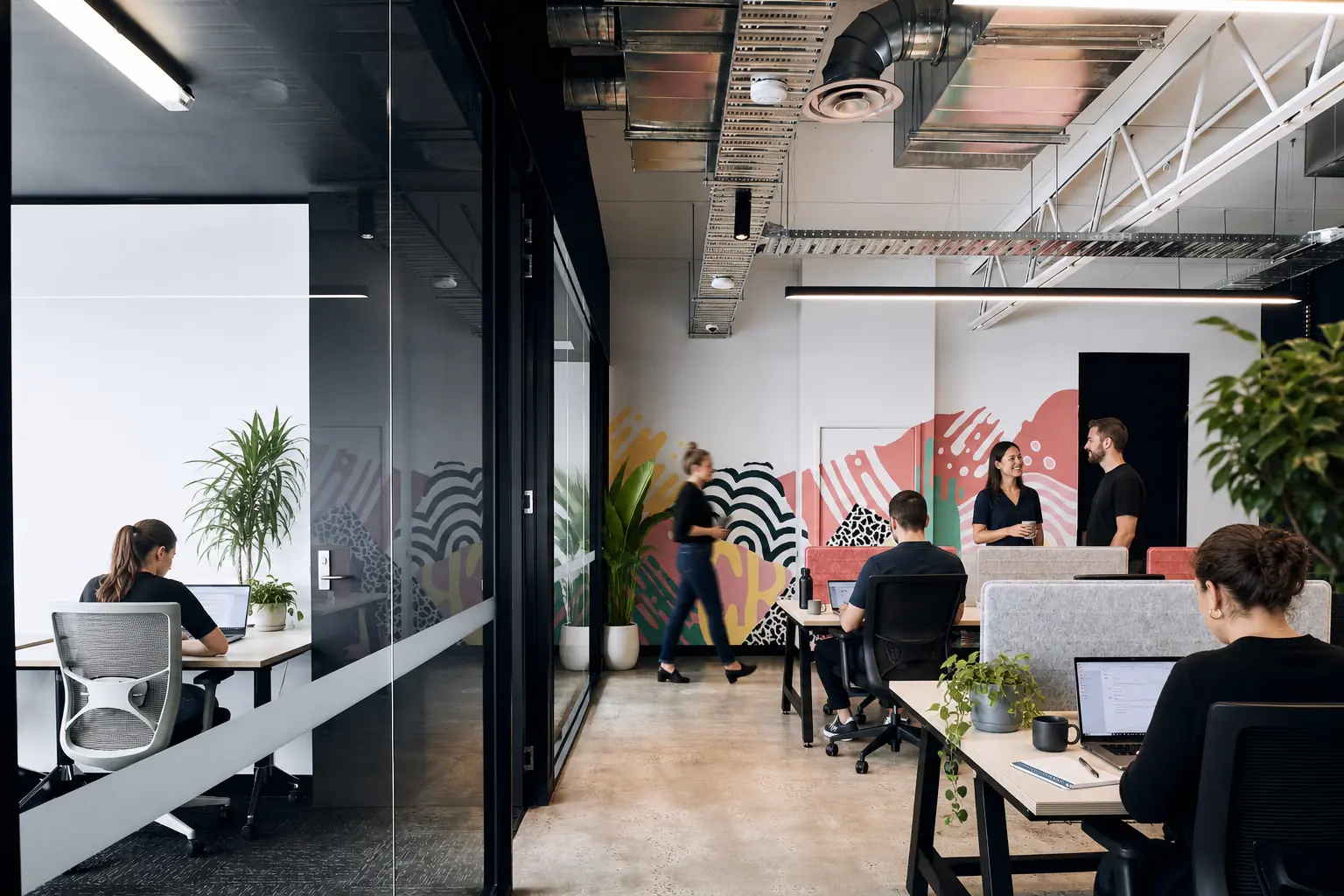
Employee Engagement in Traditional Offices: 7 Office Gaps Hurting Professional Firms
Employee engagement in traditional offices is becoming harder to protect, especially for mid-sized professional firms trying to balance productivity, culture, flexibility and staff retention.
The office still matters. However, the old version of the office – fixed desks, rigid hours, limited shared spaces and long leases – is no longer enough for teams that need focus, collaboration, flexibility and energy.
For law firms, accounting practices, advisory businesses, consultancies, engineering firms and other professional service teams, the office is more than a place to sit. It shapes client confidence, staff performance, team rhythm and workplace culture.
When the office does not support how people actually work, engagement drops. Quietly at first. Then all at once.
Gallup’s 2026 workplace data shows only 21% of Australian employees are engaged at work, highlighting a real opportunity for employers to rethink the work environment as part of their staff retention strategies.
Why Office Design Now Impacts Engagement
Professional firms have traditionally leaned on prestige, central locations and permanent office footprints. That worked when the office was the default.
Today, the equation has changed.
Staff want flexibility, better work-life balance, quiet spaces, collaboration zones and a reason to commute. Leesman’s workplace research found that 91% of employees like hybrid working, showing that flexibility is no longer a perk – it is an expectation.
The challenge is not simply remote work vs office. The real challenge is whether the office earns the commute.
Like a high-performance team, people need the right conditions to play their best. Put a striker in defence every week and don’t be shocked when goals dry up.
1. Too Many Fixed Desks, Not Enough Purpose
Traditional office leasing often starts with one question: how many desks do we need?
That question is too narrow.
A professional firm also needs:
- Quiet rooms for deep work
- Meeting rooms for client conversations
- Project spaces for team collaboration
- Informal areas for mentoring
- Video call spaces for hybrid meetings
- Breakout areas that build connection
When the office is built around fixed desks only, staff end up doing different types of work in the same environment. That creates noise, friction and fatigue.
The better question is: what types of work does our team need to perform well?
2. Poor Acoustic Control
Professional firms run on concentration and confidentiality.
If staff cannot take client calls, review sensitive files or think deeply without background noise, office environment satisfaction drops quickly.
This is one of the most common professional firm challenges because open-plan layouts were often designed for density, not performance.
Poor acoustic control can lead to:
- Reduced focus
- More stress
- Lower call quality
- Less confidential comfort
- Increased avoidance of the office
The fix is not always more space. Often, it is smarter space.
Flexible workspace alternatives can provide private offices, meeting rooms, quiet zones and phone booths without forcing firms into oversized leases.
3. Limited Flexibility for Hybrid Work
Many firms are still carrying office models designed for five-day attendance, even though their staff now operate across office, home, client sites and third spaces.
That mismatch hurts workplace engagement.
If people are only in the office two or three days per week, the office needs to work harder on those days. It must support collaboration, team energy, mentoring and client-facing professionalism.
Microsoft’s Work Trend Index research highlights the importance of trust and flexibility in hybrid work culture.
Rigid offices often create the worst of both worlds:
- Too much space on quiet days
- Not enough meeting rooms on peak days
- Poor coordination across teams
- A commute that does not feel worthwhile
A better model gives firms access to the right mix of private offices, shared amenities, meeting rooms and flexible capacity.
4. No Real Space for Mentoring and Learning
Professional firms are built on knowledge transfer.
Junior staff learn by listening, watching, asking questions and being close to experienced operators. However, when the office is either too rigid or too empty, mentoring becomes accidental instead of intentional.
This is where the office can still beat remote work.
But only if the space supports it.
Strong mentoring environments usually need:
- Informal meeting areas
- Shared lounges
- Project rooms
- Private spaces for feedback
- Team days with enough energy in the building
If the office feels flat, disconnected or purely transactional, younger staff lose one of the biggest reasons to be there.
5. Weak Client Experience
For professional firms, the office is part of the brand.
Clients notice the arrival experience, meeting room quality, reception, hospitality, technology and atmosphere.
A tired or poorly configured office can quietly damage confidence. On the other hand, a polished workplace with strong meeting rooms, reception services and professional energy can lift the client experience immediately.
This matters because staff also feel the brand.
When people are proud to bring clients into the office, engagement rises. When they apologise for the space, momentum drops.
6. Long Leases That Cannot Keep Up With Change
Traditional office leasing often locks firms into a size, cost base and layout before they know what the next three years will look like.
That creates risk.
Mid-sized professional firms can change quickly due to:
- Hiring growth
- Mergers
- Partner movements
- Hybrid work adoption
- New service lines
- Market slowdowns
- Project-based teams
Long-term leases can make firms overcommit to space they do not need or under-resource teams that are growing.
This directly affects staff retention strategies because the workplace starts feeling either cramped, stale or financially inefficient.
Flexible workspace alternatives allow firms to scale up, scale down or access extra meeting and project space without carrying every square metre permanently.
7. Lack of Energy, Community and Connection
Engagement is not created by furniture alone.
People want to feel part of something. They want momentum, connection and a workplace that gives them energy rather than draining it.
Leesman has reported a strong link between workplace community and productivity, with employees who feel a strong sense of community reporting much higher productivity than those who do not.
For professional firms, this does not mean turning the office into a circus. No one needs a ping-pong table pretending to be culture.
It means designing for real connection:
- Better shared spaces
- Strong hospitality
- Events and learning moments
- Cross-team visibility
- Client-ready meeting areas
- Spaces where people want to spend time
The best offices help people feel more connected to the firm, not just physically present in it.
The Better Alternative: Flexible Workspaces Built Around Performance
Employee engagement in traditional offices suffers when the space is rigid, underused or disconnected from how people work today.
Flexible workspace models give professional firms a smarter way forward.
They can support:
- Private offices for core teams
- Meeting rooms for clients
- Reception and concierge services
- Shared amenities
- Flexible lease terms
- Project rooms
- Event spaces
- Hybrid work rhythms
- Scalable growth
Instead of carrying every cost on the balance sheet, firms can access a more agile workplace model that supports staff, clients and commercial performance.
That is the real win.
Not office vs remote. Not old school vs new school.
It is about giving your people the right environment to do their best work.
Takeaway
The office is not dead. The average office is just under pressure.
For mid-sized professional firms, workplace engagement depends on whether the office supports focus, flexibility, connection, client experience and growth.
If your office is hurting engagement, the answer may not be more space. It may be better space.
Book A Tour
If you’re ready to improve employee engagement with a workplace that actually supports your team?
Book a tour and explore flexible office solutions designed for professional firms that need privacy, polish, flexibility and room to grow.
FAQs
What is employee engagement in traditional offices?
Employee engagement in traditional offices refers to how connected, motivated and supported staff feel when working from a conventional office environment. It is influenced by office design, flexibility, leadership, culture, technology, commute value and the quality of workplace experience.
Why do traditional offices hurt workplace engagement?
Traditional offices can hurt workplace engagement when they are too rigid, noisy, poorly designed or disconnected from how people work today. Fixed desks, limited meeting rooms, weak acoustics and inflexible leases can reduce focus, collaboration and staff satisfaction.
How does office design affect professional firm challenges?
Office design affects professional firm challenges by influencing productivity, confidentiality, client experience, mentoring and team culture. A poorly designed office can make it harder for staff to focus, collaborate and feel connected to the business.
Is remote work better than the office?
The remote work vs office debate is not one-size-fits-all. Remote work can improve flexibility and focus, while the office can improve collaboration, mentoring and client experience. The strongest model for many professional firms is a flexible hybrid approach.
What office features improve staff retention strategies?
Strong staff retention strategies are supported by offices that include quiet zones, quality meeting rooms, flexible work options, strong hospitality, collaboration areas and professional client-facing spaces. Staff are more likely to stay when the workplace helps them perform and feel valued.
How can flexible workspaces improve office environment satisfaction?
Flexible workspaces can improve office environment satisfaction by giving firms access to private offices, meeting rooms, shared amenities and scalable space without the burden of long-term leases. This helps firms adapt as team needs change.
What should professional firms look for in a workspace?
Professional firms should look for privacy, acoustic control, meeting room access, reception services, flexible terms, strong technology, client-ready presentation and enough shared space to support team culture. The goal is a workspace that supports both performance and people.