

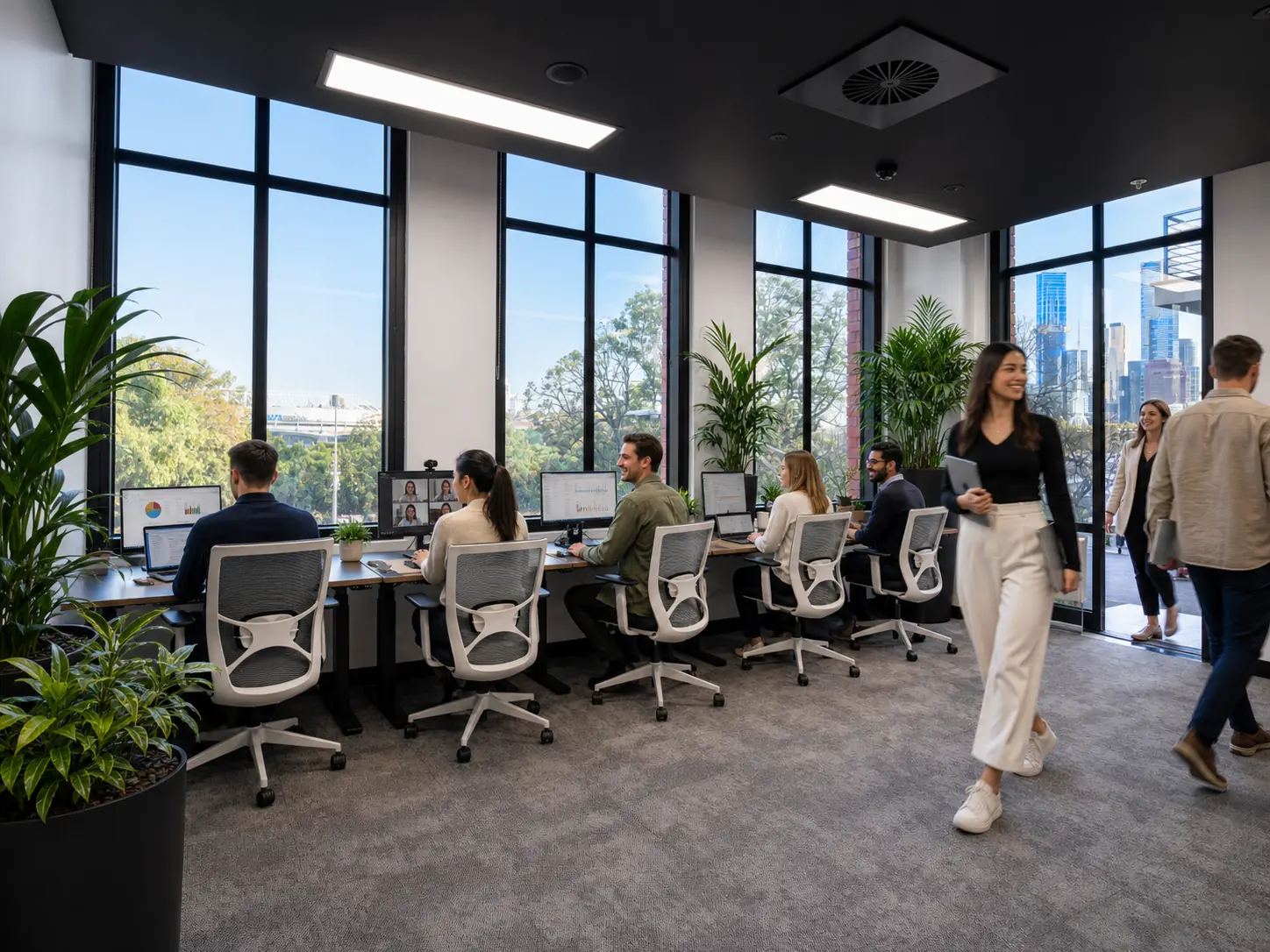
Flexible Workspace vs Office Lease.
Choosing an office used to follow a familiar formula.
Find a building. Estimate how many people the business might employ in five years. Sign a long-term lease. Spend heavily on the fitout. Then hope the original forecast proves accurate.
That model still suits some organisations. However, it can create serious constraints for small businesses operating in a faster, less predictable market.
Teams grow, restructure and adopt hybrid work. Customer demand changes. New technology alters how people collaborate. Yet a traditional office lease remains fixed.
This is why office space scalability has become one of the most important considerations when choosing a workplace.
The decision is no longer simply about how much space your business needs today. It is about how quickly and economically that space can change tomorrow.
This guide compares flexible workspace with traditional office leasing to help business leaders choose the model that best supports growth.
What Is Office Space Scalability?
Office space scalability is the ability to increase, reduce or reconfigure your workplace as business requirements change.
A scalable office solution may allow your business to:
- Add desks as the team grows
- Move into a larger private office
- Reduce space after restructuring
- Accommodate temporary project teams
- Access additional meeting rooms
- Use multiple locations
- Enter a new market without another long-term lease
- Adjust capacity around hybrid attendance
- Book event or training space when required
Scalability is not simply about having more space available.
True scalability means being able to change your workplace without excessive cost, delay or operational disruption.
Think of it like building a sporting squad. You need enough capacity to compete today, but you should not lock every future position into a five-year contract before knowing how the season will unfold.
What Is a Flexible Workspace?
A flexible workspace is a professionally managed workplace that provides businesses with office space, shared facilities and services under shorter, more adaptable agreements.
Depending on the provider, flexible workspace may include:
- Furnished private offices
- Dedicated desks
- Flexible coworking desks
- Day offices
- Meeting and boardrooms
- Project spaces
- Training rooms
- Business lounges
- Event venues
- Reception services
- Mail handling
- Podcasting and content studios
- Kitchens and cafés
- Access across multiple locations
Internet, electricity, furniture, cleaning and workplace management are commonly included within the membership fee.
A business can usually move in quickly without designing a fitout, purchasing furniture or coordinating multiple service providers.
What Is a Traditional Office Lease?
A traditional office lease is an agreement between a tenant and landlord for exclusive use of commercial premises over an agreed period.
The business generally takes responsibility for creating and operating its workplace.
This may involve:
- Negotiating the lease
- Providing a security deposit or bank guarantee
- Designing and constructing the fitout
- Purchasing furniture
- Installing internet and technology
- Arranging electricity and utilities
- Managing cleaning
- Maintaining equipment
- Paying relevant outgoings
- Managing workplace repairs
- Restoring the premises when the lease ends
Traditional leasing gives the business greater control over its environment. However, that control comes with greater financial commitment and operational responsibility.
The Office Market
Businesses currently have considerable office choice.
Overall office vacancy reached 19% in January 2026, increasing from 17.9% in July 2025. Prime office vacancy was 19.1%, while secondary vacancy reached 18.5%.
High vacancy can create negotiating opportunities, including incentives and a broader choice of premises.
However, an available office is not automatically a scalable or economical office.
The business may still need to fund:
- Fitout costs
- Legal and advisory fees
- Furniture
- Security requirements
- Technology installation
- Operating expenses
- Future make-good obligations
More options on the market can improve the deal. They do not remove the structural commitments of a traditional lease.
At the same time, Australia’s flexible workspace market is expanding beyond freelancers and startups. Flexible Workspace Australia’s 2026 industry research indicates that flexible workspace is increasingly being used by established companies as well as smaller businesses.
The choice for businesses is therefore broader than “coworking or a real office”.
Modern flexible workspace can provide a secure, branded and professional private office supported by the facilities of a much larger workplace.
Flexible Workspace vs Traditional Office Lease
| Consideration | Flexible workspace | Traditional office lease |
|---|---|---|
| Agreement length | Typically shorter and more adaptable | Usually a longer commitment |
| Setup time | Often ready immediately | Fitout can take several months |
| Upfront capital | Generally lower | Fitout and establishment costs can be substantial |
| Furniture | Usually included | Purchased or leased separately |
| Internet and utilities | Commonly included | Arranged by the tenant |
| Meeting rooms | Shared and booked when needed | Built and funded by the tenant |
| Reception | May be included | Managed or employed by the tenant |
| Expansion | Move or add space where available | May require additional premises |
| Downsizing | Often possible under agreed terms | Difficult during the lease |
| Branding | Some customisation may be available | Greater control |
| Office management | Managed by the provider | Managed by the tenant |
| Cost certainty | Consolidated monthly membership | Multiple property and operating costs |
| Exit flexibility | Shorter notice periods may apply | Early exit can be complex and expensive |
1. Compare the Full Cost, Not Just the Rent
One of the most common mistakes when comparing workplaces is placing monthly flexible workspace fees beside the base rent of a vacant office.
That is not a fair comparison.
A traditional office lease can include costs such as:
- Base rent
- Annual rent increases
- Operating outgoings
- Fitout design and construction
- Furniture
- Legal fees
- Security deposits or bank guarantees
- Electricity
- Internet and telecommunications
- Cleaning
- Repairs and maintenance
- Insurance
- Security
- Meeting-room technology
- Kitchen supplies
- Workplace management
- End-of-lease make-good
A flexible workspace membership may combine many of these expenses into one regular payment.
The Australian Government recommends considering operating costs, accessibility, future growth and whether premises meet both current and future business requirements when selecting a location.
To compare the models properly, calculate the total cost over the expected occupancy period.
Traditional lease calculation
Include:
- Total rent across the lease
- Estimated annual increases
- Outgoings
- Initial capital expenditure
- Finance costs
- Operating expenses
- Staff time spent managing the workplace
- Expected make-good costs
- The cost of unused space
Flexible workspace calculation
Include:
- Monthly membership
- Meeting-room overages
- Additional memberships
- Printing or service charges
- Parking
- Expansion costs
- Annual price changes
The right question is not, “Which monthly number is lower?”
It is, “Which option delivers the best operational value with an acceptable level of risk?”
2. Understand the Long-Term Lease Challenges
Traditional leases are designed to provide certainty for both parties.
For a stable business, that certainty can be valuable. For a growing business, it can also become restrictive.
Common long-term lease challenges include:
Forecasting headcount too early
A business may need to estimate its space requirements three, five or even ten years ahead.
If the forecast is too conservative, the business can run out of room. If it is too ambitious, it pays for desks that remain empty.
Carrying unused space
Hybrid work has made daily office attendance less predictable. A business may employ 30 people but rarely have more than 18 in the office simultaneously.
A lease based on total headcount can create significant underutilisation.
Limited ability to downsize
Revenue, staffing or strategy may change, but the lease obligation remains.
Subleasing or assigning space can take time and may require landlord approval.
Expansion without continuity
When a team outgrows its premises, suitable space may not be available in the same building. Expansion can trigger another property search, negotiation and fitout.
Capital tied up in property
Money committed to fitout, furniture and security cannot simultaneously fund recruitment, technology, marketing or product development.
Operational distraction
Running an office involves more than paying rent. Someone must manage suppliers, repairs, cleaning, access, deliveries, technology and the everyday issues that keep a workplace functioning.
These responsibilities may be manageable for a large company with a property team. They can become a significant distraction for a small business.
3. Match Business Growth and Office Space
The relationship between business growth and office space is rarely linear.
A business may:
- Hire rapidly after securing investment
- Add contractors for a six-month project
- Establish a sales team in another city
- Reduce permanent desks after introducing hybrid work
- Need larger meeting rooms without needing more desks
- Bring the whole team together only once per week
- Require temporary space during a merger or relocation
A scalable workplace should respond to these changes.
Flexible workspace allows businesses to purchase access to an ecosystem rather than permanently leasing every possible facility.
For example, a ten-person team may occupy a private office while accessing:
- A boardroom for customer meetings
- A project room for planning sessions
- An event venue for a product launch
- A podcast studio for content
- A lounge for informal conversations
- Temporary desks for visiting employees
Under a traditional lease, the business would need to fund much of that space permanently, even when it was rarely used.
4. Consider the Cost of Empty Desks
Unused office space still costs money.
Rent, outgoings, cleaning and utilities do not disappear because employees work from home on Mondays and Fridays.
Before selecting an office, measure actual workplace attendance.
Review:
- Total employees
- Average daily attendance
- Peak daily attendance
- Team overlap days
- Customer meeting frequency
- Remote and interstate employees
- Planned recruitment
- Temporary project requirements
Build the workplace around peak practical demand rather than total theoretical headcount.
Flexible workspace can help businesses accommodate high-attendance days through shared lounges, bookable desks, meeting rooms and project spaces without maintaining that capacity every day.
5. Compare Speed to Occupancy
A traditional office can take months to secure and prepare.
The process may include:
- Property search
- Commercial negotiations
- Legal review
- Design
- Building approvals
- Fitout construction
- Furniture installation
- Internet connection
- Testing and commissioning
- Physical relocation
Delays can leave the business paying for temporary space, operating inefficiently or carrying overlapping property costs.
A flexible private office is generally furnished, connected and operational.
For businesses facing an upcoming lease expiry, rapid hiring or a new market opportunity, speed can be more valuable than achieving complete control over the fitout.
Momentum matters. A workplace should help the business get onto the field, not keep it waiting in the change room.
6. Assess Workspace Flexibility for Hybrid Teams
Hybrid work does not simply mean reducing the number of desks.
An effective hybrid workplace needs to support different types of work, including:
- Individual concentration
- Video calls
- Confidential conversations
- Team collaboration
- Customer meetings
- Training
- Social connection
- Company-wide gatherings
A smaller conventional office filled entirely with desks may not provide this variety.
Flexible workspaces can give teams access to multiple environments within one membership.
When comparing providers, check for:
- Private offices
- Phone booths
- Quiet zones
- Meeting rooms
- Video-conferencing technology
- Collaboration spaces
- Project rooms
- Business lounges
- Event facilities
- Access to multiple locations
The office must give employees a reason to attend.
A commute becomes worthwhile when the workplace offers better collaboration, stronger connection and more professional facilities than people can access remotely.
7. Consider Your Need for Control and Branding
Traditional office leasing offers greater control.
The business can potentially select:
- Layout
- Furniture
- Colours and materials
- Signage
- Access systems
- Meeting-room technology
- Kitchen facilities
- Brand presentation
This can be important for businesses with specialised operational requirements or a highly specific customer experience.
Flexible workspace involves some shared presentation and operating rules. However, many providers allow members to customise private offices with signage, screens, furniture and brand elements.
Ask:
- Can we install external signage?
- Can the office be branded?
- Can furniture be moved or replaced?
- Can we install dedicated technology?
- Can access permissions be customised?
- Can customers locate our business easily?
- Can the provider create a dedicated team suite?
For many small businesses, a professionally designed shared environment can project a stronger brand than an independently leased office built under a limited fitout budget.
8. Evaluate Privacy, Security and Technology
Flexible does not need to mean exposed.
Modern flexible workspace can provide lockable private offices, secure access, dedicated networks and confidential meeting areas.
Before committing, assess:
- Office acoustics
- Visual privacy
- Lockable storage
- Secure printing
- Wi-Fi security
- Dedicated internet options
- Building access controls
- Visitor management
- After-hours security
- Data-handling requirements
- Mail and package security
Professional firms working with financial, legal, health or confidential customer information should have their technology and compliance requirements reviewed.
A traditional lease may allow complete control of the environment. A capable flexible workspace provider may still meet the required standard while removing much of the setup burden.
9. Compare Exit Risk
A traditional lease may be difficult to leave early.
Depending on the agreement, a business may need to:
- Continue paying rent
- Negotiate a surrender
- Find an assignee
- Sublease the premises
- Pay legal costs
- Meet incentive repayment obligations
- Complete make-good works
Victorian Small Business Commission guidance recommends carefully reviewing lease rights and obligations before seeking an early exit. It also notes that security deposits can equal one or more months’ rent, with the amount negotiated between the parties.
Flexible workspace agreements also have notice periods and exit conditions. They are not consequence-free.
However, the shorter commitment and lower establishment cost can reduce the financial exposure associated with a change in direction.
Always review:
- Minimum term
- Notice period
- Renewal conditions
- Deposit
- Annual increases
- Early termination
- Office-change fees
- Expansion rights
- Downsizing options
Flexibility should be written into the agreement, not assumed from the sales pitch.
10. Consider Multi-Location Access
Growth does not always happen within one office.
A business may hire people across different suburbs, meet customers in the CBD or expand interstate.
A multi-location flexible workspace network can provide:
- Alternative places for employees to work
- CBD meeting locations
- Space closer to customers
- Interstate business addresses
- Temporary offices for travelling employees
- Faster entry into new markets
- Continuity during building disruptions
With a traditional lease, each new location may require a separate agreement, fitout and operational setup.
Network access can therefore become an important part of scaling business operations, particularly for distributed teams.
When Flexible Workspace Is the Better Choice
Flexible workspace may be the stronger option when:
- Team size is changing
- The business follows a hybrid model
- Capital needs to remain available for growth
- The office is needed quickly
- The business wants predictable operating costs
- Meeting and collaboration space is important
- Multiple locations would add value
- Management does not want to operate the office
- The business is entering a new market
- Long-term headcount is uncertain
When a Traditional Office Lease May Be Better
Traditional office leasing may be more appropriate when:
- Headcount is large and highly stable
- The business expects to remain for many years
- A specialised fitout is required
- Complete branding control is essential
- Security requirements demand a fully controlled premises
- The business needs exclusive use of substantial facilities
- An internal team can manage the property
- The economics remain attractive across the full lease term
The choice should be driven by operating strategy, not outdated assumptions about what a “proper” office looks like.
Office Space Scalability Checklist
Before selecting either model, ask:
- How many people use the office on an average day?
- What is our peak attendance?
- How reliable is our three-year headcount forecast?
- Can we expand without relocating?
- Can we reduce space if conditions change?
- What is the complete occupancy cost?
- How much upfront capital is required?
- How long will setup take?
- What facilities will we use every day?
- Which facilities do we only need occasionally?
- Who will manage the workplace?
- What happens if we need to leave early?
- Can employees access other locations?
- Does the workplace support hybrid collaboration?
- Will customers be proud to meet us there?
Frequently Asked Questions
Is flexible workspace more expensive than leasing an office?
The monthly cost per desk may appear higher, but flexible workspace often includes furniture, internet, utilities, cleaning, reception and shared facilities. Compare the total occupancy cost rather than rent alone.
What is the biggest risk of a long-term office lease?
The biggest risk is committing to a fixed amount of space based on an uncertain forecast. If the business grows, contracts or changes its working model, the lease may no longer match its needs.
Can flexible workspace support an established business?
Yes. Flexible workspace is used by small businesses, professional firms, project teams and enterprise organisations. Private suites can provide security and brand presence while retaining access to shared facilities.
Is flexible workspace suitable for hybrid work?
Yes. Flexible workspace can support hybrid teams through private offices, bookable desks, meeting rooms, collaboration areas, video-call facilities and multi-location access.
Can a business customise a flexible private office?
Many providers allow signage, screens, furniture changes and other brand elements. The available customisation depends on the provider, office and agreement.
How long are flexible workspace agreements?
Terms vary from short monthly arrangements to multi-year agreements. Longer commitments may attract better pricing, while shorter terms provide greater adaptability.
What happens if we outgrow our flexible office?
Subject to availability, the provider may allow the business to add desks, move into a larger office, combine offices or access another location. Expansion options should be discussed before signing.
Build a Workplace Around Growth
Office space should support the business you are building, not anchor it to a forecast made years earlier.
CreativeCubes.Co gives businesses access to fully furnished private offices, meeting rooms, reception services, collaboration spaces, event venues, podcasting studios, cafés and a connected business community.
Our flexible workspace network helps businesses expand, contract and adapt without rebuilding their workplace strategy every time the team changes.
That is what genuine office space scalability looks like.
Book a tour of CreativeCubes.Co and find a workspace built to move with your business.