

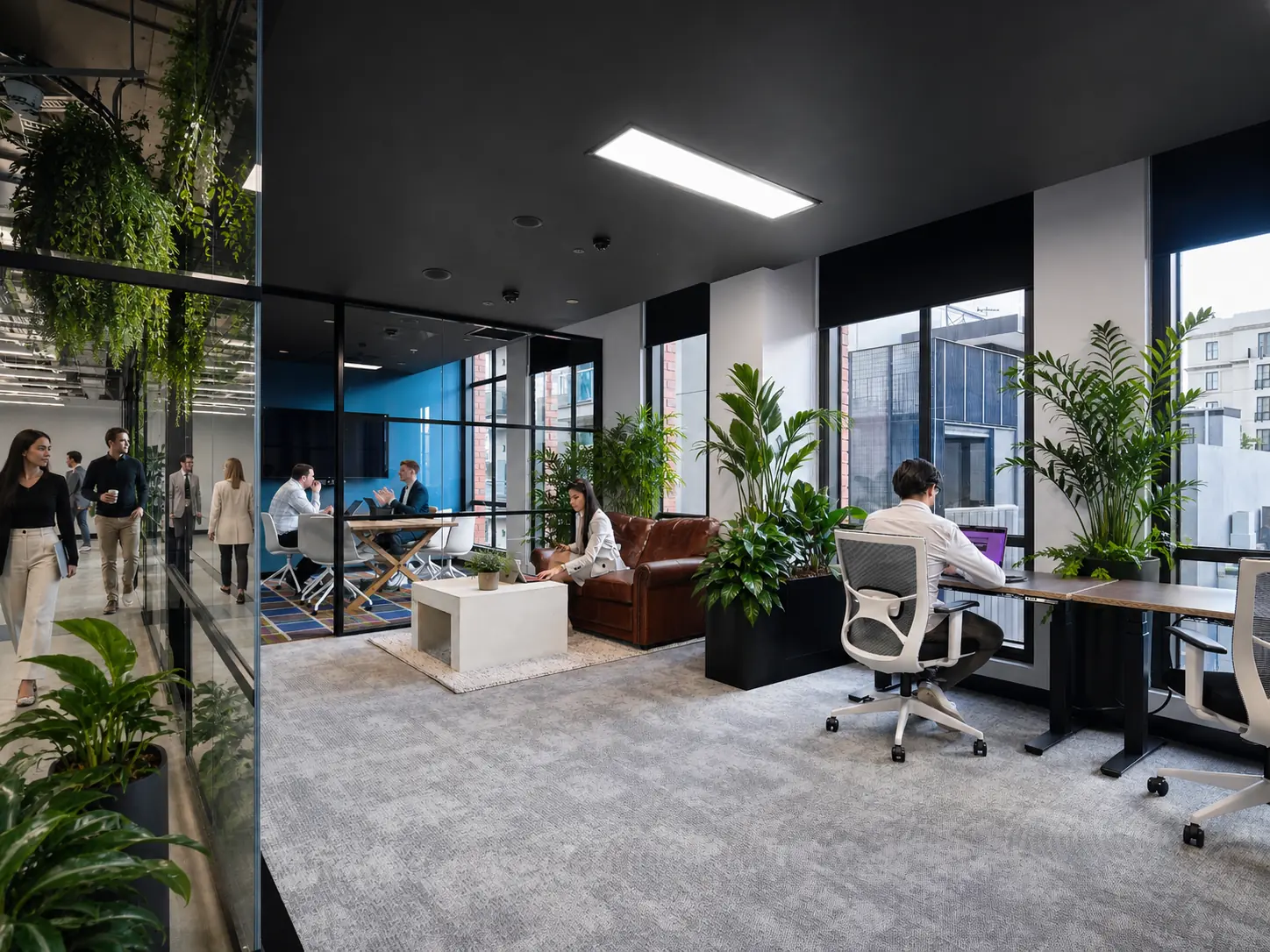
Choosing the Right Serviced Private Office.
The best office is not necessarily the biggest, newest or cheapest.
It is the one that helps your people perform, gives customers confidence and allows the business to grow without carrying unnecessary property costs.
That is why serviced private offices have become a serious workplace strategy for Melbourne small businesses, professional firms and hybrid teams.
A serviced office combines the privacy of a traditional office with shared access to meeting rooms, reception services, internet, technology, kitchens, lounges and collaboration spaces. Instead of committing significant capital to a fitout and signing a lengthy commercial lease, businesses can move into a furnished, operational office under more flexible terms.
With Australia recording more than 2.7 million actively trading businesses at 30 June 2025, including almost one million employing businesses, demand for adaptable workplace solutions continues to grow.
The challenge is knowing which serviced office will genuinely support your business.
This guide explains exactly what to compare before making the call.
What Is a Serviced Private Office?
A serviced private office is a secure, fully furnished office managed by a flexible workspace provider.
Unlike an open coworking desk, the office is exclusively occupied by your business. Your team can work behind a closed door while sharing professionally managed facilities with other businesses in the building.
A typical membership may include:
- A lockable, furnished private office
- Business-grade internet
- Electricity and utilities
- Cleaning and maintenance
- Reception services
- Mail and package handling
- Meeting rooms
- Kitchens and breakout areas
- Business lounges
- Printing facilities
- Building and office access
- Community and business events
- Access to other locations
Some providers also offer event spaces, training rooms, mediation rooms, podcast studios, content-production facilities and cafés.
The result is a workplace that is ready from day one. Your business can arrive with its laptops and begin operating without spending months designing, constructing and managing an office.
Why Serviced Private Offices Matter.
Australian workplace needs have changed.
Teams may work together in the office for part of the week, work remotely on other days and bring everyone together for meetings, workshops or customer presentations.
Flexible Workspace Australia identifies hybrid work and increasing demand for private offices as major forces shaping the flexible workspace market. Businesses are looking for adaptable workplaces without the rigidity of traditional commercial property.
Fair Work also recognises that flexible working arrangements can include changes to work hours, patterns and locations. This makes workplace flexibility something employers must actively consider rather than treat as a temporary experiment.
In 2026, the office must provide more than attendance capacity.
It needs to support:
- Concentrated individual work
- Confidential conversations
- Team collaboration
- Video meetings
- Customer presentations
- Training and workshops
- Social connection
- Business growth
- Changing daily attendance
A strong serviced office gives the business a permanent professional home while preserving the flexibility to change.
1. Begin With Your Actual Workspace Requirements
Before booking tours, define how your team will use the office.
Start with these questions:
- How many people are employed by the business?
- How many people attend on the busiest day?
- Which days have the highest attendance?
- Does every employee need a permanent desk?
- How often do customers visit?
- Are confidential meetings common?
- How many video calls happen each day?
- Will the team expand during the next 12 to 24 months?
- Do employees need access to multiple locations?
- Will the business hold events, training or workshops?
Do not simply count employees and rent the same number of desks.
A 15-person hybrid team may only require ten permanent workstations if attendance is properly managed. However, squeezing 15 people into an office designed for ten whenever the full team gathers will quickly damage the experience.
Choose an office that works comfortably during peak attendance, not only on the quietest day of the week.
2. Choose the Right Type of Private Office
Not all private office spaces provide the same experience.
Internal private offices
These offices may have no external windows but can offer a lower price and greater privacy. They may suit small teams that spend limited time in the office or use shared lounges throughout the day.
Windowed private offices
Natural light can improve the atmosphere and make the office feel more spacious. These offices generally attract a premium but may provide a stronger everyday experience for permanent teams.
Executive suites
Executive suites typically provide a more premium environment, higher-quality finishes and greater space per person. They can suit advisory firms, consultants, legal teams and businesses hosting senior customers.
Team suites
Larger team suites may include internal meeting rooms, executive offices or breakout areas. They can offer greater independence while retaining access to the wider workspace.
Project offices
Project offices provide short-term capacity for temporary teams, contractors or customer projects. They can be particularly valuable when a business needs additional space without changing its permanent office.
Compare the office layout with the way your people actually work. Ten desks placed inside a room do not automatically make it a functional ten-person office.
3. Calculate the Total Cost, Not Just the Office Price
The advertised monthly price is only the starting point.
Ask the provider to outline every included service and potential additional charge.
Check whether the price includes:
- Furniture
- Internet
- Electricity
- Cleaning
- Reception services
- Mail handling
- Meeting-room credits
- Printing
- Kitchen access
- Tea and coffee
- After-hours access
- Security passes
- Signage
- Access to other locations
- Events and community programs
- Parking or bicycle storage
Also ask about:
- Establishment fees
- Deposits
- Additional access cards
- Additional team members
- Meeting-room overages
- Internet upgrades
- Office changes
- End-of-term cleaning
- Early termination
- Annual price increases
The correct comparison is not:
Serviced office membership versus base rent.
It is:
Serviced office membership versus the complete cost of leasing, fitting out, operating and managing a traditional office.
The Australian Government recommends considering location, business growth, operating costs and whether a property meets current and future requirements when selecting business premises.
Traditional offices can involve rent, outgoings, utilities, furniture, construction, security, cleaning, insurance, technology, maintenance and make-good costs.
A serviced office combines many of these expenses into a more predictable operating cost.
4. Inspect the Office at Full Capacity
An empty private office can feel much larger than it will once occupied.
When inspecting the space, imagine every workstation in use.
Check:
- Space between desks
- Chair movement
- Storage capacity
- Natural light
- Ventilation
- Temperature control
- Power outlets
- Internet connectivity
- Noise transfer
- Internal acoustics
- Video-call privacy
- Space for bags and personal items
- Proximity to bathrooms and kitchens
- Access to quiet areas
Ask whether the quoted capacity is the recommended capacity or simply the maximum number of desks that can physically fit.
There is a considerable difference.
A serviced private office should give people enough room to work productively throughout the day. A crowded office may look economical on a spreadsheet but become expensive when frustration, noise and poor attendance follow.
5. Evaluate the Meeting Rooms Properly
Meeting rooms are often one of the most valuable parts of a serviced office membership.
They allow a business to occupy an appropriately sized private office while accessing larger rooms only when needed.
However, the words “meeting rooms available” do not tell you enough.
Ask:
- How many meeting rooms are available?
- What capacities do they support?
- How far ahead can rooms be booked?
- How quickly do popular times fill?
- Are monthly credits included?
- What happens when credits run out?
- Can bookings be extended?
- Are there minimum booking periods?
- Can external guests access the rooms easily?
- Is video-conferencing technology included?
- Are rooms acoustically private?
- Are boardrooms available?
- Can rooms be booked after hours?
- Are training and workshop spaces available?
A professional firm may need confidential rooms for customer meetings. A hybrid team may need video-enabled rooms for meetings involving remote employees. A growing business may need larger collaboration spaces for monthly planning sessions.
Tour the actual rooms, test the technology and understand the booking system before signing.
6. Assess the Reception Services
Reception is not simply someone sitting near the entrance.
Good reception services shape the experience of every customer, candidate, partner and employee entering the workspace.
A professional reception team may:
- Welcome visitors
- Notify members when guests arrive
- Manage mail and deliveries
- Direct customers to meeting rooms
- Assist with room setup
- Provide refreshments
- Help resolve workplace issues
- Support events and functions
- Maintain the presentation of shared areas
Ask:
- What hours is reception staffed?
- How are visitors announced?
- Can reception answer calls for your business?
- Is mail handling included?
- Can packages be stored securely?
- Will the team assist with customer meetings?
- What happens outside normal business hours?
- Is the service consistent across locations?
Visit during a busy period and observe how people are welcomed.
Your customers will not distinguish between the workspace provider’s reception team and your own business. The experience reflects on your brand either way.
7. Compare Flexible Lease Terms Carefully
One of the central advantages of serviced private offices is flexibility.
But “flexible” can mean different things between providers.
Compare:
- Minimum agreement length
- Renewal structure
- Notice period
- Deposit requirements
- Annual increases
- Ability to add desks
- Ability to move offices
- Options to expand or downsize
- Early-exit conditions
- Access to temporary overflow space
- Rights to use other locations
- Charges for changing the agreement
The shortest agreement is not automatically the best agreement.
Very short terms can carry higher prices or provide less certainty that the office will remain available. Longer agreements may deliver better pricing but reduce your ability to adapt.
The right balance depends on the stability of your team, cash flow and growth plans.
For many small and mid-sized businesses, flexible lease terms are valuable because they reduce the risk of paying for space the business no longer needs.
8. Make Sure It Works as a Hybrid Workspace
A hybrid workspace should support variable attendance without making the office feel empty on quiet days or overcrowded on busy ones.
Look for:
- Flexible desk capacity
- Reliable video-conferencing rooms
- Phone booths
- Quiet work areas
- Informal collaboration spaces
- Project rooms
- Business lounges
- Day offices
- Bookable desks
- Access across multiple locations
- Technology that supports remote participants
Also consider why employees will come into the office.
People can complete focused individual tasks from many locations. The office earns its value when it makes collaboration, connection, customer meetings and team development easier.
The best hybrid workspaces give employees access to several work settings throughout the day, not one desk and one chair for eight hours.
9. Test the Internet, Technology and Security
Internet reliability is fundamental.
Ask the provider about:
- Connection speed
- Backup connections
- Network redundancy
- Dedicated networks
- Wi-Fi security
- Wired connections
- Guest access
- IT support
- Video-conferencing equipment
- Printing security
- Building access controls
- After-hours security
- Data and privacy arrangements
Professional firms may require dedicated internet networks, private printing, secure document handling or specific access controls.
Do not assume every serviced office can meet those requirements.
Have your internal technology adviser review the setup if the business handles sensitive customer, financial, legal or health information.
10. Choose a Location Your Team Will Use
A great office in the wrong location will struggle to attract consistent attendance.
For Melbourne businesses, assess:
- Proximity to trains and trams
- Travel times for employees
- Access to customers
- Parking availability
- Bicycle storage and showers
- Nearby cafés and restaurants
- Safety after hours
- Accessibility
- Local business activity
- The credibility of the address
Map where your people live and how they travel.
The most prestigious address may not be the most productive location if the journey is difficult for most of the team. Equally, a convenient office may lose value if it does not provide the environment expected by your customers.
Location should balance people, brand and commercial opportunity.
11. Look Beyond the Office Door
Your team will not spend every minute inside its private office.
Inspect the wider environment, including:
- Business lounges
- Kitchens
- Breakout spaces
- Collaboration areas
- Quiet zones
- Outdoor areas
- Event spaces
- Wellness facilities
- Cafés
- Bathrooms
- End-of-trip facilities
These shared amenities expand the effective size of your workplace without requiring you to pay permanently for every square metre.
A six-person private office supported by excellent meeting rooms, lounges and collaboration spaces can provide more utility than a larger conventional office with limited facilities.
12. Evaluate the Provider’s Community and Service
The building matters. The team operating it matters more.
Look for a provider that actively manages the member experience.
Ask:
- Is there a dedicated on-site team?
- How quickly are maintenance issues resolved?
- Are members introduced to one another?
- Are business and community events held?
- Are member businesses promoted?
- Is there support for events and activations?
- How long do members typically remain?
- Can you speak with current members?
- Does the provider have strong public reviews?
A serviced office should remove operational distractions from your business.
When the internet fails, a room needs changing or a customer arrives early, the on-site team should take ownership. That support allows your people to focus on customers, performance and growth.
13. Confirm the Provider Can Support Your Growth
Many businesses choose startup office solutions based only on what they need today.
That can lead to another office search six months later.
Ask whether the provider can support:
- A larger private office
- Additional desks
- Temporary project teams
- New locations
- Interstate expansion
- Short-term swing space
- Customer events
- Team training
- Podcasting and content production
- Larger meeting and boardrooms
- Enterprise technology requirements
A workspace network can allow a Melbourne business to establish a presence in another market without signing another long-term lease.
The best provider should help your business move through several stages of growth, not only sell you the office currently available.
Serviced Private Office vs Traditional Lease
| Consideration | Serviced private office | Traditional office lease |
|---|---|---|
| Setup time | Usually ready to occupy | Fitout may take several months |
| Initial capital | Generally lower | Fitout, furniture and security can be substantial |
| Agreement length | Shorter and more flexible | Commonly longer-term |
| Furniture | Usually included | Purchased or leased separately |
| Internet and utilities | Often included | Arranged and managed by the tenant |
| Reception | Shared service may be included | Tenant employs or manages its own |
| Meeting rooms | Shared and booked as required | Tenant funds dedicated rooms |
| Expansion | Subject to provider availability | May require more premises |
| Office management | Handled by the provider | Managed by the tenant |
| Branding control | Some limitations | Greater control |
| Cost structure | More consolidated | Multiple occupancy and operating costs |
Here is a great snapshot we built out and how we compare
When Is a Serviced Private Office the Right Choice?
A serviced office may be suitable when:
- You want to move quickly
- Team numbers may change
- Hybrid work makes attendance variable
- You want to preserve capital
- Customers regularly visit
- Meeting rooms are important
- Reception support adds value
- You need professional facilities
- You do not want to manage an office
- You want access to multiple locations
A traditional lease may be more suitable when:
- Your space requirements are highly stable
- You need a heavily customised fitout
- Specialist infrastructure is essential
- Complete branding control is required
- You expect to occupy the same premises for many years
- Your business has the resources to manage the property
Neither option wins every contest.
It is like selecting a playing system. The right structure depends on your team, your stage of growth and the conditions in front of you.
Serviced Private Office Inspection Checklist
Before signing, confirm:
- The office comfortably fits your team
- Peak attendance has been considered
- The total monthly cost is clear
- All additional fees are documented
- The location works for employees and customers
- Meeting rooms are available when required
- Video-conferencing technology is reliable
- Reception hours and services are understood
- Internet and security requirements are satisfied
- The notice period suits the business
- Expansion and downsizing options are available
- Shared areas are clean and well managed
- Current members provide positive feedback
- The provider offers genuine on-site support
- The agreement has been independently reviewed where appropriate
Where possible, arrange a trial day.
A normal working day will reveal the noise, service, room availability and energy of the workspace far more accurately than a brief sales tour.
Frequently Asked Questions
What is included in a serviced private office?
Most serviced private offices include furniture, internet, electricity, cleaning and access to shared facilities. Reception services, meeting-room credits, mail handling, printing and multi-location access vary between providers.
Are serviced private offices suitable for professional firms?
Yes. Private offices can provide the security, presentation and confidentiality required by consultants, accountants, legal teams, financial advisers and other professional firms. The provider’s privacy, acoustic and technology standards should be reviewed carefully.
How much does a serviced private office cost?
Pricing depends on location, office size, natural light, building quality, agreement length and included services. Compare the complete monthly cost rather than price per desk alone.
What are flexible lease terms?
Flexible lease terms generally refer to shorter commitments, simpler agreements and options to change office size. Notice periods, minimum terms and exit conditions still apply and should be checked before signing.
Can serviced offices support hybrid teams?
Yes. Serviced offices are well suited to hybrid work when they provide meeting rooms, phone booths, collaboration spaces, video-conferencing facilities and flexible capacity for peak attendance.
What is the difference between a serviced office and coworking?
A serviced office gives one business exclusive use of a lockable private office. Coworking commonly refers to open or shared desk areas, although many flexible workspace providers offer both options within the same location.
Can we use the address for our business?
Many providers allow members to use the location as their business and mailing address. Confirm whether this is included, whether signage is available and whether any restrictions apply.
Can a serviced office accommodate business growth?
Often, yes. Providers may allow teams to add desks, move into larger offices or access additional locations. These options depend on availability, so expected growth should be discussed before committing.
Choose an Office That Moves With Your Business
The right serviced private office should give your team privacy without isolation, flexibility without uncertainty and professional facilities without the burden of managing them yourself.
CreativeCubes.Co provides fully furnished private office spaces supported by meeting rooms, reception services, collaboration areas, business lounges, event venues, cafés and a connected business community.
Our flexible workspace network is designed for growing small businesses, professional firms, startups and hybrid teams that need more than four walls and a Wi-Fi password.
Choose a workplace that works as hard as your team does.
Book a tour and experience the space, service and community for yourself.