

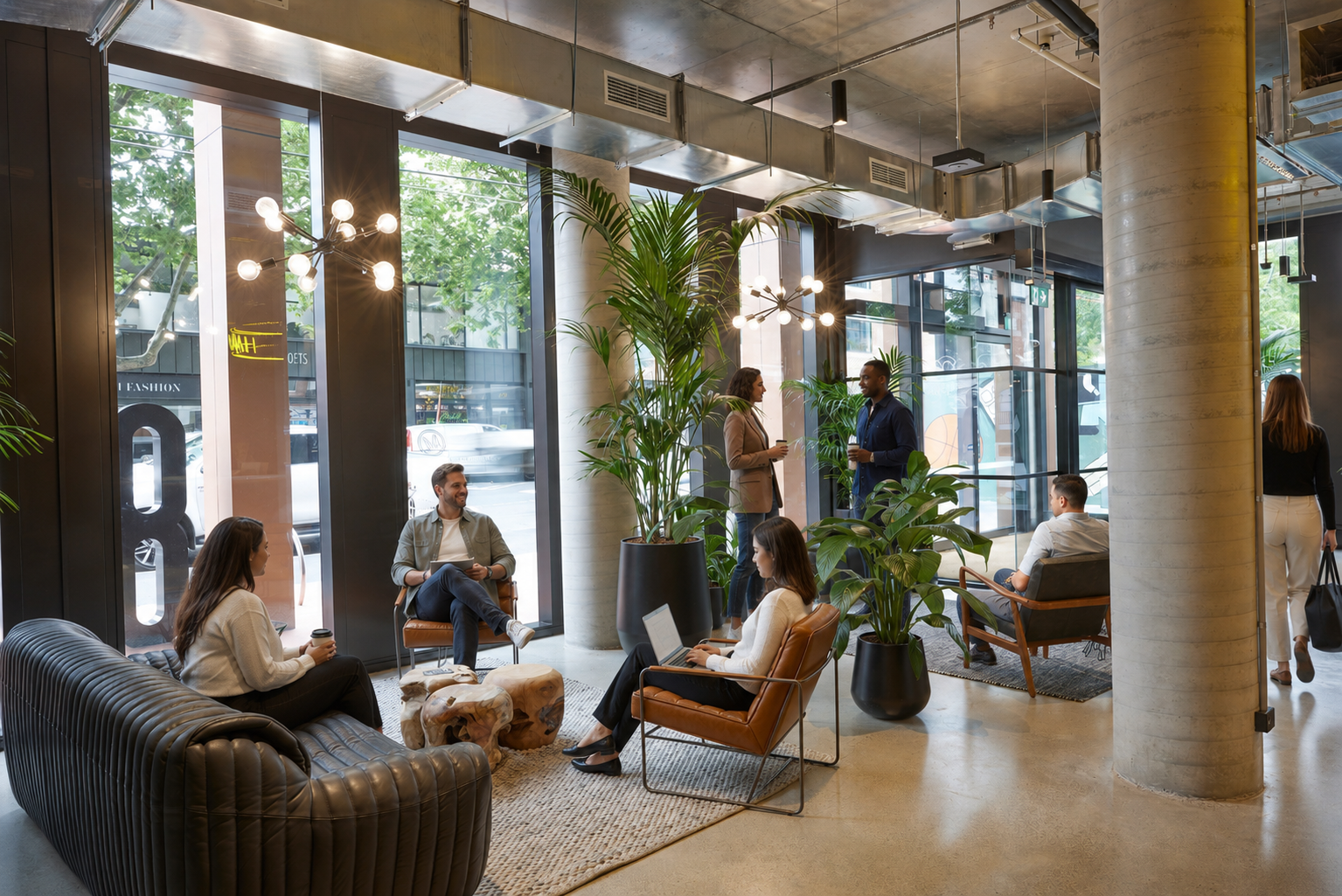
Coworking vs traditional office space is no longer simply a choice between shared desks and having your own front door.
For growing Australian businesses, it is a decision about where to invest capital, how much property risk to carry and whether the workplace can adapt as the team changes.
A traditional office lease may appear to offer stability and control. However, the advertised rent rarely represents the true cost of occupying and operating the space.
The fit-out must be designed and funded. Furniture needs to be purchased. Internet, security, cleaning, reception, maintenance and workplace compliance need to be managed. Then there is the security deposit, legal work and potential make-good liability at the end of the lease.
Suddenly, the inexpensive office does not look quite so inexpensive.
CreativeCubes.Co’s comparison model examines a 10-person company taking a minimum two-year workspace agreement against a traditional five-year lease. In that example, the traditional lease requires an estimated $187,000 in initial capital, compared with $0 in initial capital outlay under the CreativeCubes.Co model. Estimated ongoing monthly costs are also shown as $9,000 for the traditional lease and $8,500 for CreativeCubes.Co.
That is capital that could otherwise be invested into people, product, technology, marketing or growth.
In basketball terms, a traditional lease can look like an open shot. The hidden occupancy costs are the defender arriving from your blind side.
Coworking vs Traditional Office: The Quick Comparison
| Consideration | CreativeCubes.Co workspace | Traditional office lease |
|---|---|---|
| Initial capital outlay in the comparison model | $0 | $187,000 |
| Estimated monthly cost | $8,500 | $9,000 |
| Typical commitment in the example | Minimum two years | Five years |
| Security requirement | Two months | Up to six months |
| Fit-out | Ready to use | Usually funded and managed by tenant |
| High-speed internet | Included | Arranged separately |
| Front desk support | Included | Additional staffing cost |
| Cleaning and maintenance | Managed | Tenant responsibility |
| Security monitoring | Managed | Tenant responsibility |
| Kitchen amenities | Included | Purchased, stocked and maintained |
| Guest management | Included | Tenant must arrange |
| Community and events | Built into the experience | Usually not available |
| Scaling the workplace | More flexible | Restricted by leased footprint |
| End-of-term make-good exposure | Reduced | Potentially significant |
The figures above are based on CreativeCubes.Co’s illustrative 10-person comparison and will vary depending on location, building, agreement, team size and workplace requirements.
The important point is not that every coworking space will always be cheaper.
It is that businesses must compare the total cost of occupancy, not simply the advertised rent.
The $187,000 Question: Where Does the Money Go?
Traditional office leases often require businesses to spend heavily before the first employee opens a laptop.
Potential establishment costs include:
- Workplace design and consultancy
- Construction and fit-out
- Desks, chairs and storage
- Meeting room furniture
- Kitchen equipment
- Internet and network infrastructure
- Audiovisual equipment
- Access control and security
- Signage and branding
- Legal and property advisory fees
- Bank guarantees or security deposits
- Removal and make-good costs
These expenses are not minor.
JLL’s 2026 Australia and New Zealand Fit-Out Cost Guide reports that the average Australian cost for a moderate-style, medium-quality office fit-out reached approximately $3,011 per square metre in the first quarter of 2026. JLL also found that fit-out costs had increased between 3.5% and 6% year-on-year across Australian states.
At that rate, fitting out a relatively modest 100-square-metre office could represent approximately $301,100 before considering the lease deposit, ongoing operations and future make-good obligations.
The precise number will depend on the building and specification. However, the strategic question remains the same:
Does owning and managing an office fit-out create enough value to justify tying up that capital?
For many growing businesses, the answer is no.
Headline Rent Is Not the Real Cost of an Office
A traditional lease usually begins with a simple number: annual rent per square metre.
That number can become dangerously misleading when used as the only basis for comparison.
The true monthly cost may also include:
- Building outgoings
- Electricity and utilities
- Internet services
- Cleaning
- Repairs and maintenance
- Security
- Reception support
- Kitchen supplies
- Waste management
- Insurance
- IT and audiovisual support
- Workplace health and safety requirements
- Facilities management
- Replacement furniture
- Meeting room technology
- Annual rent increases
Coworking and flexible office memberships generally combine many of these services into a more predictable monthly cost.
You are not only paying for the office. You are paying for the operational platform around it.
That distinction matters because a workplace should help the business perform. It should not quietly become another business that management needs to operate.
Traditional Leases Lock In Space Before You Know What You Need
A five-year lease requires a business to make long-term property decisions using short-term information.
How many people will the company employ in three years?
How many days will employees attend the office?
Will the team remain in the same city?
Will the business acquire another company?
Will an important client require a project team to work from a different location?
Will new technology change how much space the team needs?
No leadership team can answer every question with certainty.
However, a traditional lease still demands a fixed answer.
Lease too little space and the business can outgrow the office. Lease too much and the company pays for empty desks, unused meeting rooms and square metres that generate no return.
Flexible workspace gives businesses more room to adjust. Teams can begin with the space they need today, then expand, reduce or reconfigure their footprint as conditions change.
It is the workplace equivalent of keeping a strong bench. You have capacity available without paying every player to remain on the court for the entire game.
Hybrid Work Has Changed the Office Calculation
The office is no longer occupied evenly across five days.
CBRE’s 2025 Australian Occupier Survey found that average office utilisation across Australia was approximately 52% during the week, increasing to 67% on peak days. Activity was commonly concentrated between Tuesday and Thursday.
This creates a significant problem for traditional leases.
Businesses must maintain enough space for peak attendance while carrying the cost of that space on quieter days.
As a result, companies can end up paying full-time property costs for a workplace that is used at close to half its capacity across an average week.
The same CBRE survey found that flexible office space represented an average of 15.5% of Australian occupiers’ property portfolios, up from 7.2% in 2022.
That growth reflects a broader shift towards more adaptable property strategies.
Flexible workspace allows organisations to match their office footprint more closely to real usage. It can support permanent teams, hybrid employees, project groups, travelling staff and temporary expansion without requiring every scenario to be covered by one fixed lease.
Coworking Is No Longer Just for Freelancers
The old image of coworking was a room filled with freelancers, early-stage founders and laptops.
The sector has moved well beyond that stereotype.
Flexible Workspace Australia, the national peak body for coworking and flexible workspace providers, has highlighted the expansion of the sector into corporate teams, regional centres, private offices and larger enterprise requirements.
Modern coworking can include:
- Secure private offices
- Dedicated team rooms
- Enterprise workspace
- Hot desks and business lounges
- Meeting rooms
- Training facilities
- Event spaces
- Podcast and content studios
- Reception and concierge support
- Multi-location access
- Member programming and business events
CreativeCubes.Co private offices can accommodate teams ranging from two to 350 people and provide access to a wider ecosystem of locations, meeting rooms, collaborative areas and member services.
This means a team can retain privacy and control without taking responsibility for an entire leased environment.
The Office Must Earn the Commute
Employees do not travel into an office simply because the company is paying rent.
The workplace must give them something they cannot get at home.
That may include:
- Better collaboration
- Stronger team connection
- Professional meeting environments
- Access to leaders
- Creative energy
- Client engagement
- Learning opportunities
- Community
- Events and introductions
- Better technology
- Separation between home and work
CBRE found that 65% of surveyed Australian occupiers were focused on improving employee experience through the workplace. Location was a priority for 83% of organisations considering lease renewals, while 77% identified improved amenities and services as important when considering relocation.
This is where a high-quality coworking environment can outperform a basic leased office.
A private room in a quiet building may technically provide desks. It may not provide the energy, hospitality, amenities or community required to make people genuinely want to attend.
CreativeCubes.Co combines private workspace with front desk support, cafés, meeting rooms, wellness facilities, kitchens, collaborative zones, networking opportunities and business services.
The result is not simply somewhere to work.
It is an environment designed to help people connect, perform and build momentum.
The Hidden Management Cost of a Traditional Office
Every office requires someone to run it.
In a traditional lease, responsibilities can quickly spread across founders, executive assistants, operations managers, finance teams, people and culture teams or office managers.
Someone must deal with the internet provider.
Someone must call the cleaner.
Someone must replace the broken chair.
Someone must greet the client.
Someone must organise access cards.
Someone must manage the air conditioning issue.
Someone must make sure the kitchen is stocked.
Each task may look small. Together, they become operational drag.
Flexible workspace transfers much of that responsibility to an experienced onsite team.
At CreativeCubes.Co, services can include office cleaning, mail handling, concierge support, guest reception, janitorial services and broader business support.
That allows members to focus on the work that actually grows their business.
What About Privacy and Brand Control?
There are circumstances where a traditional office lease can be the right choice.
A long-term lease may suit a business that:
- Requires highly specialised infrastructure
- Operates laboratories, production facilities or regulated environments
- Needs complete control over building access
- Has a stable long-term headcount
- Intends to remain in one location for many years
- Requires extensive custom branding
- Has enough scale to justify an internal facilities team
- Can efficiently use most of its footprint throughout the week
Coworking should not automatically win every comparison.
The right decision depends on business strategy.
However, privacy does not necessarily require a traditional lease. Private offices within a flexible workspace can provide secure, dedicated team space while retaining access to shared amenities and onsite support.
The question is not, “Do we want privacy?”
The better question is, “How much property infrastructure do we need to own and manage to achieve it?”
Seven Signs Your Business Has Outgrown the Traditional Lease Model
1. Your headcount changes frequently
Rapid hiring, restructuring and project-based teams make it difficult to select a fixed office size.
2. Your team works on a hybrid schedule
Paying for one permanent desk per employee may no longer reflect how the workplace is used.
3. Capital is better invested elsewhere
Fit-out funds may deliver a stronger return when directed towards people, systems, customer acquisition or product development.
4. Your leaders are managing facilities problems
Senior people should not spend their time chasing cleaners, internet providers or maintenance contractors.
5. Your current office feels empty
An underutilised workplace can damage energy and culture while continuing to absorb rent.
6. Your business needs multiple locations
A flexible workspace network can provide access across different business districts without requiring a separate lease in each market.
7. Your lease is restricting decisions
Property should support the strategy. The strategy should not be dictated by an office agreement signed several years ago.
How to Calculate the Real Cost of a Traditional Office Lease
Before comparing a lease with coworking, calculate the following:
Step 1: Add all upfront costs
Include the security deposit, legal fees, design, construction, furniture, IT infrastructure, equipment and relocation expenses.
Step 2: Calculate total monthly operating costs
Include rent, outgoings, electricity, internet, cleaning, maintenance, security, insurance, kitchen supplies and facilities support.
Step 3: Calculate internal labour
Estimate the number of employee hours spent operating and managing the workplace.
Step 4: Account for unused space
Measure average weekly attendance and calculate the proportion of the office that is genuinely being used.
Step 5: Include end-of-lease exposure
Review make-good requirements, removal costs and potential reinstatement obligations.
Step 6: Price the risk of change
Consider the financial impact if the team grows, contracts, relocates or adopts a different hybrid work model.
Step 7: Compare like with like
Compare the traditional office’s complete cost with everything included in the flexible workspace membership.
Do not compare a bare lease with a fully serviced office and pretend the products are identical.
Coworking vs Traditional Office: Which Is Better?
For businesses that value complete physical control, specialised infrastructure and long-term certainty, a traditional lease may remain appropriate.
For growing companies that value flexibility, cost certainty, team experience and reduced operational friction, coworking and flexible private offices can provide a stronger platform.
The answer is usually determined by four factors:
- Certainty: How predictable is your future headcount and location strategy?
- Capital: Is funding an office fit-out the best use of your money?
- Utilisation: How frequently will the space be occupied?
- Experience: Will the workplace help attract people and improve performance?
A traditional office gives you a fixed asset to manage.
A flexible workspace gives you an operating environment to use.
That difference can become significant as a company grows.
Why Growing Teams Choose CreativeCubes.Co
CreativeCubes.Co is built for teams that want their own professional space without inheriting the full cost and complexity of a traditional lease.
Members can access:
- Secure private offices
- Flexible workspace options
- High-speed internet
- Meeting rooms
- Front desk and guest support
- Cleaning and maintenance
- Shared kitchens and cafés
- Wellness and end-of-trip facilities
- Collaborative areas
- Community events
- Business connections
- Multiple locations
- Spaces that can evolve with the team
Instead of spending months designing, constructing and operating an office, teams can move into an established environment and begin working.
No construction project.
No furniture shopping marathon.
No frantic call because the Wi-Fi has disappeared five minutes before a client presentation.
Just a workspace that is ready to perform.
Before You Sign Another Office Lease
A long-term office lease is not simply a property decision.
It is a capital allocation decision, an operational decision, a workplace experience decision and a bet on what the business will look like several years from now.
Before signing, calculate the real cost.
Add the fit-out. Add the deposit. Add the services. Add the internal time. Add the unused space. Add the cost of changing direction.
Then compare it with a flexible workplace built to absorb those responsibilities.
The difference may not only be financial.
It may determine how quickly your business can respond to its next opportunity.
Ready to compare the real numbers? Book a tour of CreativeCubes.Co and explore a private workspace designed around the way your team works today and where it is heading next.
Frequently Asked Questions
What is the difference between coworking and a traditional office?
Coworking provides access to ready-to-use workspace, shared amenities and business services through a membership or flexible agreement. A traditional office normally requires the tenant to lease, fit out, furnish and operate the premises independently.
Is coworking cheaper than a traditional office lease?
Coworking can be more cost-effective when establishment costs, fit-out, internet, cleaning, reception, security, maintenance and other operating expenses are included. Businesses should compare the total cost of occupancy rather than looking only at base rent.
How much does it cost to fit out an office in Australia?
JLL reported an average cost of approximately $3,011 per square metre for a moderate-style, medium-quality Australian office fit-out in the first quarter of 2026. The final cost will vary according to location, quality, building condition, technology and design requirements.
Are coworking spaces suitable for established companies?
Yes. Modern coworking spaces can accommodate established businesses, professional firms, project teams and larger organisations through secure private offices, team suites and enterprise workspace solutions.
Can my team have a private office in a coworking space?
Yes. Private coworking offices provide dedicated and secure space for one business while still offering access to shared meeting rooms, kitchens, lounges, facilities and onsite support.
Is coworking suitable for hybrid teams?
Coworking is particularly well suited to hybrid teams because businesses can select a footprint based on actual attendance rather than providing a permanent desk for every employee. Additional meeting rooms and shared spaces can support higher-attendance days.
What costs are normally hidden in a traditional office lease?
Costs can include outgoings, fit-out, furniture, internet, utilities, security, cleaning, repairs, maintenance, legal fees, facilities management and end-of-lease make-good work.
When is a traditional office lease the better option?
A traditional lease may be suitable when a business requires highly specialised infrastructure, complete control over the premises, extensive customisation or a stable long-term footprint that will be consistently utilised.
How long are coworking agreements?
Agreement lengths vary by provider and workspace type. Options can range from casual day access and monthly memberships to longer private office agreements. Flexible terms allow businesses to select a structure that matches their current plans.
Can a coworking office be customised?
Many private offices can be configured or customised for the team, including layouts, furniture, branding and access requirements. The available options will depend on the office and agreement.