

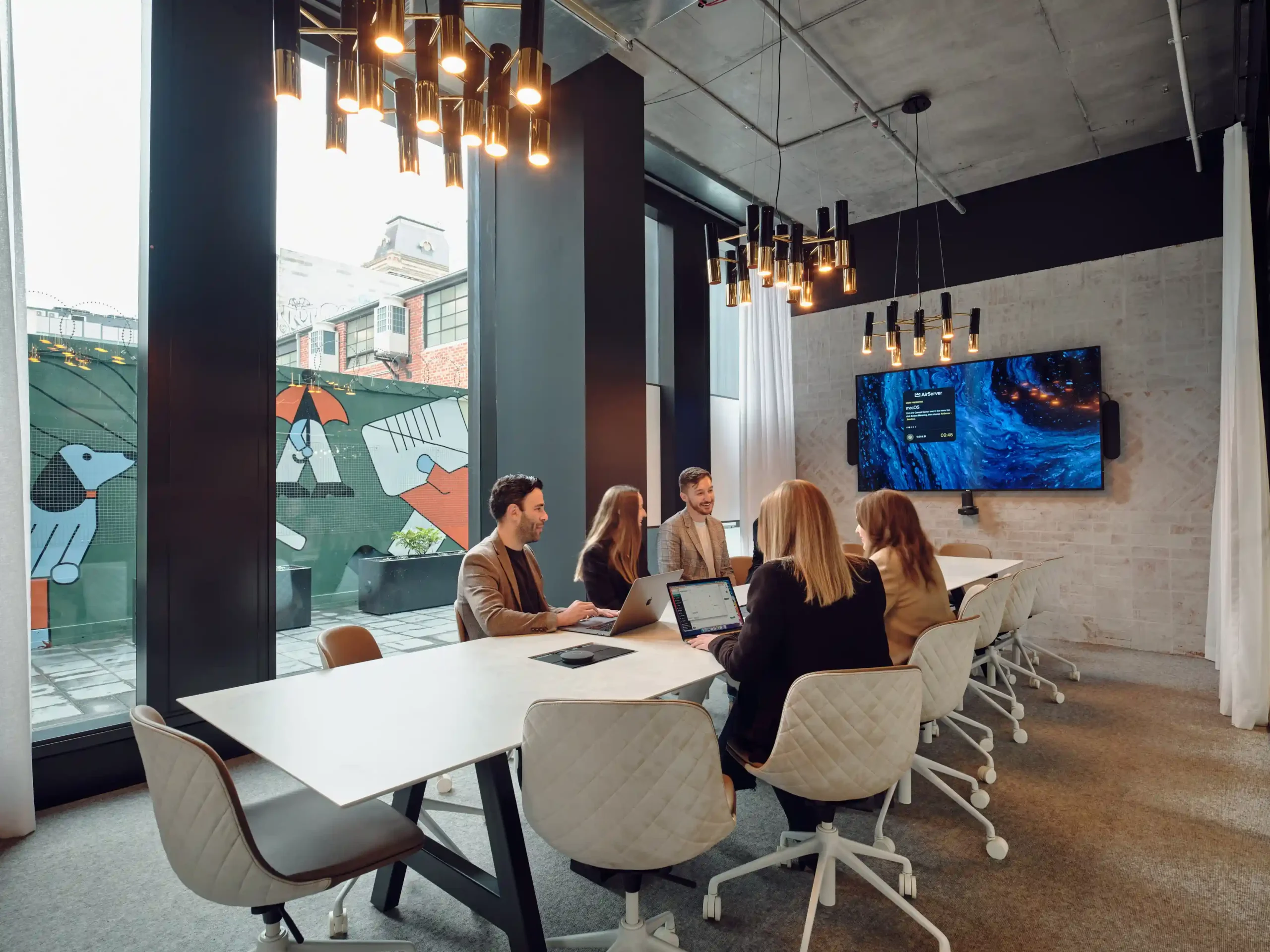
Creative businesses do their best work when the environment supports both focus and energy.
Teams need quiet space to think, room to collaborate, somewhere professional to meet clients and enough flexibility to change as the business grows. At the same time, they should not have to spend weeks managing furniture, internet, utilities, cleaning and office administration.
That is where serviced private offices create real value.
A serviced private office gives your team its own dedicated workspace within a professionally managed environment. You get the privacy and consistency of a traditional office, supported by shared meeting rooms, breakout spaces, onsite teams and a broader business community.
For creative agencies, startups, consultants, technology companies and growing small businesses, it can provide the right balance between independence and connection.
What Are Serviced Private Offices?
Serviced private offices are enclosed, lockable workspaces managed by a flexible workspace provider.
The office is exclusively used by your team, while the broader environment, facilities and services are operated for you.
Depending on the location and membership, serviced private offices may include:
- Fully furnished private offices
- High-speed internet
- Meeting rooms and boardrooms
- Reception and visitor support
- Cleaning and utilities
- Secure building access
- Shared kitchens and breakout spaces
- Community events
- Mail and package handling
- Onsite workplace support
- Technology-enabled room booking
Instead of building an office from scratch, your team can move into a workspace that is already operational.
That means less time choosing chairs and chasing internet providers, and more time doing the work clients actually pay you for.
Why Creative Teams Need More Than a Desk
Creative work moves between different modes.
One moment, the team needs deep focus. The next, it needs to workshop ideas, present concepts, record content or host a client meeting.
A single open desk does not always support that range of activity.
Serviced private offices provide a consistent home base where teams can:
- Protect focused work time
- Collaborate without disturbing others
- Meet clients professionally
- Store equipment and materials
- Build stronger team routines
- Create a visible business identity
- Stay connected to a wider community
For creative companies, the office should not feel like a row of desks under fluorescent lights. It should support movement, interaction and momentum.
The best workspace acts like a strong studio or training facility. It gives people the environment, tools and energy to perform.
Privacy Without Isolation
Many growing teams want the privacy of their own office but do not want to operate in a disconnected corporate environment.
Serviced private offices can provide both.
Your team has a dedicated room with greater control over sound, access and daily routines. Outside the office, there are shared lounges, meeting spaces, kitchens and community areas where people can connect naturally.
This model can work particularly well for:
- Creative agencies
- Marketing teams
- Designers
- Content companies
- Technology startups
- Consultants
- Production teams
- Architects
- Recruitment firms
- Small professional businesses
The office gives the team ownership of its own environment, while the wider community creates opportunities to meet clients, collaborators, suppliers and potential partners.
Meeting Rooms and Reception That Strengthen Your Brand
Creative companies are often judged by how they present ideas.
A strong client meeting needs more than good work. The room, technology, arrival experience and overall environment all contribute to how the business is perceived.
Client-ready meeting rooms
Professional meeting rooms give teams somewhere to:
- Present campaigns
- Pitch for new business
- Conduct strategy workshops
- Run interviews
- Host hybrid meetings
- Review creative work
- Meet suppliers and partners
- Facilitate team planning sessions
When evaluating meeting rooms, consider:
- Availability during busy periods
- Screen and presentation technology
- Video conferencing capability
- Room size and layout
- Sound privacy
- Booking processes
- Included usage or credits
- Additional booking costs
- Catering options
- After-hours access
A beautifully designed meeting room is helpful. A beautifully designed meeting room with technology that works is much better.
Reception and visitor support
Reception support can help create a smooth and professional arrival experience.
An onsite team may assist by:
- Welcoming guests
- Directing visitors
- Notifying your team when clients arrive
- Managing deliveries
- Supporting meeting room access
- Answering general location questions
- Helping resolve day-to-day workspace issues
This allows smaller companies to create a strong front-of-house experience without employing a dedicated receptionist.
The result is a business that feels established, organised and ready for the meeting before the first slide appears.
Flexible Lease Terms for Growing Companies
Creative businesses rarely grow in a perfectly straight line.
A new client win may require more people. A major project may need temporary space. A quieter period may change how much office capacity is required.
Traditional leases are not always designed for that level of movement.
They can require long commitments, fitout costs, furniture purchases, guarantees and ongoing maintenance obligations. For growing businesses, those fixed commitments can become a burden.
Flexible lease terms can help companies respond more quickly.
Depending on the provider and office availability, businesses may be able to:
- Start with a smaller office
- Move into a larger space as the team grows
- Choose shorter agreement terms
- Add desks or neighbouring offices
- Access other locations
- Reduce unnecessary setup costs
- Move in sooner
Flexibility protects the business from paying for tomorrow’s team before tomorrow arrives.
It also allows leaders to make workspace decisions based on what the company needs now rather than locking into a long-term prediction.
Supporting Hybrid Office Setups
Hybrid work has changed what teams expect from an office.
People can complete individual tasks from home. Therefore, when they come into the office, the experience needs to offer more than a different desk and stronger coffee.
Effective hybrid office setups should support:
- Team collaboration
- Creative workshops
- Client interaction
- Learning and development
- Social connection
- Project kick-offs
- Focused individual work
- Hybrid meetings
- Team culture
Serviced private offices can give hybrid teams a reliable base while allowing attendance to change throughout the week.
A smaller dedicated office may support core team members, while shared meeting rooms and collaboration areas provide extra space when the wider team comes together.
This can help companies avoid paying for a large office that sits partially empty while still maintaining a place where people genuinely want to work.
How Community Supports Creative Growth
One of the biggest differences between a traditional lease and a community-led workspace is what happens outside the office walls.
In a traditional office, your team may only interact with itself. In a flexible workspace, the wider environment can include founders, agencies, consultants, creatives, technology companies and established businesses.
That creates more potential for:
- Referrals
- Partnerships
- New clients
- Suppliers
- Collaboration
- Introductions
- Learning
- Hiring
- Business development
Not every conversation will lead to an opportunity. However, proximity matters.
Like training alongside stronger athletes, being surrounded by motivated people can lift the energy, expectations and pace of the entire team.
For small businesses and startups, community can also reduce the isolation that often comes with building a company.
What Creative Companies Should Evaluate
Not every serviced workspace is designed for creative teams.
Before choosing an office, consider how the environment will support the way your business actually works.
1. Office privacy
Check whether the office is fully enclosed, lockable and acoustically appropriate.
Creative teams may need to discuss confidential campaigns, client information, launch plans or commercial concepts. The office should provide enough privacy for those conversations.
2. Natural light and environment
The quality of the space can affect energy and concentration.
Look at natural light, ventilation, noise levels, furniture, common areas and overall design. A workspace does not need to look like an art gallery, but it should feel considered and comfortable.
3. Collaboration spaces
Consider where the team can gather outside the private office.
Useful environments may include:
- Breakout areas
- Informal lounges
- Meeting rooms
- Workshop spaces
- Phone booths
- Event spaces
- Cafés
- Outdoor areas
Creative work often improves when teams can change environments rather than staying in one room all day.
4. Technology
Confirm what is included and how the systems work.
Review:
- Internet speed
- Wi-Fi coverage
- Guest internet access
- Video conferencing technology
- Screen connectivity
- Printing
- Secure network options
- App-based access or booking
Technology should support the work quietly in the background. It should not become the project.
5. Meeting room access
Ask how rooms are booked, how much usage is included and what happens during high-demand periods.
Agencies and consultants that hold frequent client meetings should understand the complete cost and availability before signing.
6. Community and events
Review the types of businesses already using the space and how the provider supports community connection.
Ask whether there are:
- Networking events
- Member introductions
- Business workshops
- Social gatherings
- Wellness activities
- Content opportunities
- Partner offers
Community should feel useful and natural, not forced.
7. Location
Consider how easily staff, clients and partners can reach the office.
Look at:
- Public transport
- Parking
- Nearby cafés
- Local services
- Client proximity
- After-hours accessibility
- Safety
- Surrounding business activity
A great office in the wrong location can quickly become an expensive background image for video calls.
8. Growth flexibility
Ask whether the provider can support the next stage of the company.
Can you move into a larger office? Add another room? Access another location? Bring in contractors for short periods?
The office should support growth rather than create a ceiling.
9. Total cost
Compare the full cost of each workspace option.
A traditional office may involve:
- Furniture
- Internet
- Utilities
- Cleaning
- Security
- Repairs
- Fitout
- Meeting room technology
- Kitchen supplies
- Office management
- Make-good costs
A serviced office may combine many of these into a more predictable monthly payment.
The cheapest advertised rent is not always the lowest-cost workspace.
Serviced Private Offices Versus Traditional Office Leases
A traditional lease can provide full control, but it also gives the business full responsibility.
That may suit larger companies with dedicated workplace teams and long-term certainty. However, it can be less attractive for businesses that want to remain agile.
Serviced private offices may be a better fit when the company values:
- Faster move-in
- Lower setup requirements
- Flexible lease terms
- Managed facilities
- Shared meeting rooms
- Reception support
- Community access
- Growth options
- Predictable expenses
The decision comes down to what the business wants to own.
Some companies want to own and manage the full office experience. Others want to own the culture, client relationships and creative work while leaving the property operations to someone else.
Are Serviced Private Offices Suitable for Startups?
Yes.
Serviced private offices can be effective startup workspace solutions because they remove many of the barriers involved in setting up an office.
Startups can access a credible business environment without needing to:
- Complete a major fitout
- Purchase furniture
- Coordinate multiple suppliers
- Sign a long commercial lease
- Employ office management staff
- Commit to more space than they need
As the startup grows, the office arrangement may also be able to grow with it.
However, serviced offices are not only for startups.
They can also suit established agencies, boutique consultancies, remote corporate teams and small businesses that want a professional office without the operational burden of managing one.
How CreativeCubes.Co Supports Creative Teams
CreativeCubes.Co provides flexible workspaces designed for startups, scaleups, SMEs, creative companies and growth-focused teams.
Its serviced private offices combine dedicated team space with access to professionally managed facilities, meeting rooms, shared areas and a broader business community.
Depending on the selected location and solution, teams can access:
- Furnished private offices
- Meeting rooms and boardrooms
- Shared lounges and breakout spaces
- High-speed internet
- Secure access
- Onsite Happiness Teams
- Community events
- Business introductions
- Flexible workspace arrangements
- Day offices and workspace access
- Event and activation spaces
CreativeCubes.Co is part of Cubes.Co, a collective of workspace, events, hospitality, community and business experience brands.
Within the Cubes.Co network, CreativeCubes.Co is built for founders, growing teams, SMEs and creative businesses that value energy, connection and community.
CorporateCubes.Co serves professional, corporate and enterprise teams seeking a more formal business environment.
This gives businesses the ability to select a workspace experience that reflects their team, brand and stage of growth.
Questions to Ask Before Choosing a Serviced Office
Before committing to an office, ask:
- What is included in the monthly fee?
- Is the office fully private and lockable?
- How many meeting room hours are included?
- What additional charges apply?
- What agreement terms are available?
- What notice period is required?
- Can the office support team growth?
- Is furniture included?
- How fast is the internet?
- Are secure network options available?
- Can clients visit the office?
- Is reception support available?
- What community events are offered?
- Can the team access other locations?
- Are printing, storage and parking included?
- Can the office be accessed after hours?
- What support is available onsite?
- Are event or content spaces available?
These questions make it easier to compare workspaces based on how well they support the business, not simply how they look during a tour.
Choosing Small Business Office Space That Builds Momentum
The right small business office space should make it easier to run the company.
It should help people focus, collaborate and connect. It should give clients confidence and provide enough flexibility for the business to move quickly.
Most importantly, it should support the team without becoming another full-time job to manage.
Serviced private offices give creative businesses a way to establish a consistent home base while keeping access to shared spaces, onsite support and community energy.
The office is no longer just where work happens.
Done well, it becomes part of how the team builds culture, attracts talent, wins clients and creates momentum.
Find a Serviced Private Office With CreativeCubes.Co
CreativeCubes.Co helps startups, agencies, SMEs and growing companies find flexible, professionally managed office space across Australia.
Whether your team needs a private office, somewhere to bring hybrid staff together or a stronger environment for client meetings and collaboration, CreativeCubes.Co can help you find the right fit.
Explore CreativeCubes.Co:
https://creativecubes.co/
Book a tour:
https://creativecubes.co/book-a-tour/
Frequently Asked Questions
What is included in a serviced private office?
A serviced private office may include furniture, internet, utilities, cleaning, secure access and use of shared facilities. Some memberships also include meeting room credits, reception support, mail handling and community events. Inclusions vary by workspace and membership.
Are serviced private offices suitable for creative agencies?
Yes. Serviced private offices can give agencies a dedicated space for focused work, client discussions and team collaboration while still providing access to meeting rooms, shared spaces and a wider business community.
Can startups use serviced private offices?
Yes. Serviced private offices are popular startup workspace solutions because they allow growing companies to move into a professional office without completing a fitout or signing a long traditional lease.
Can clients visit a serviced private office?
Yes. Most professional serviced workspaces support client visits and provide access to reception areas, meeting rooms and shared business facilities.
Do serviced private offices support hybrid teams?
Yes. Serviced private offices can provide a central base for hybrid teams while meeting rooms, breakout areas and shared spaces support collaboration when more employees attend.
Are meeting rooms included?
Meeting room usage may be included through monthly credits or charged separately. Businesses should review room availability, included hours and additional costs before choosing an office.
What is the difference between coworking and a serviced private office?
Coworking usually involves working from shared desks or common areas. A serviced private office is an enclosed, dedicated workspace reserved exclusively for one team.
Are serviced offices more flexible than traditional leases?
Generally, serviced offices offer shorter agreements, faster move-in and fewer setup requirements than traditional office leases. Exact terms depend on the provider and location.
Can a serviced private office grow with my company?
Many workspace providers allow businesses to move into larger offices, add additional rooms or access other locations as the team grows. Expansion options depend on availability.
What types of businesses use CreativeCubes.Co?
CreativeCubes.Co supports startups, scaleups, agencies, consultants, technology companies, small businesses and creative teams seeking flexible, community-led workspace.